Eliot Borenstein
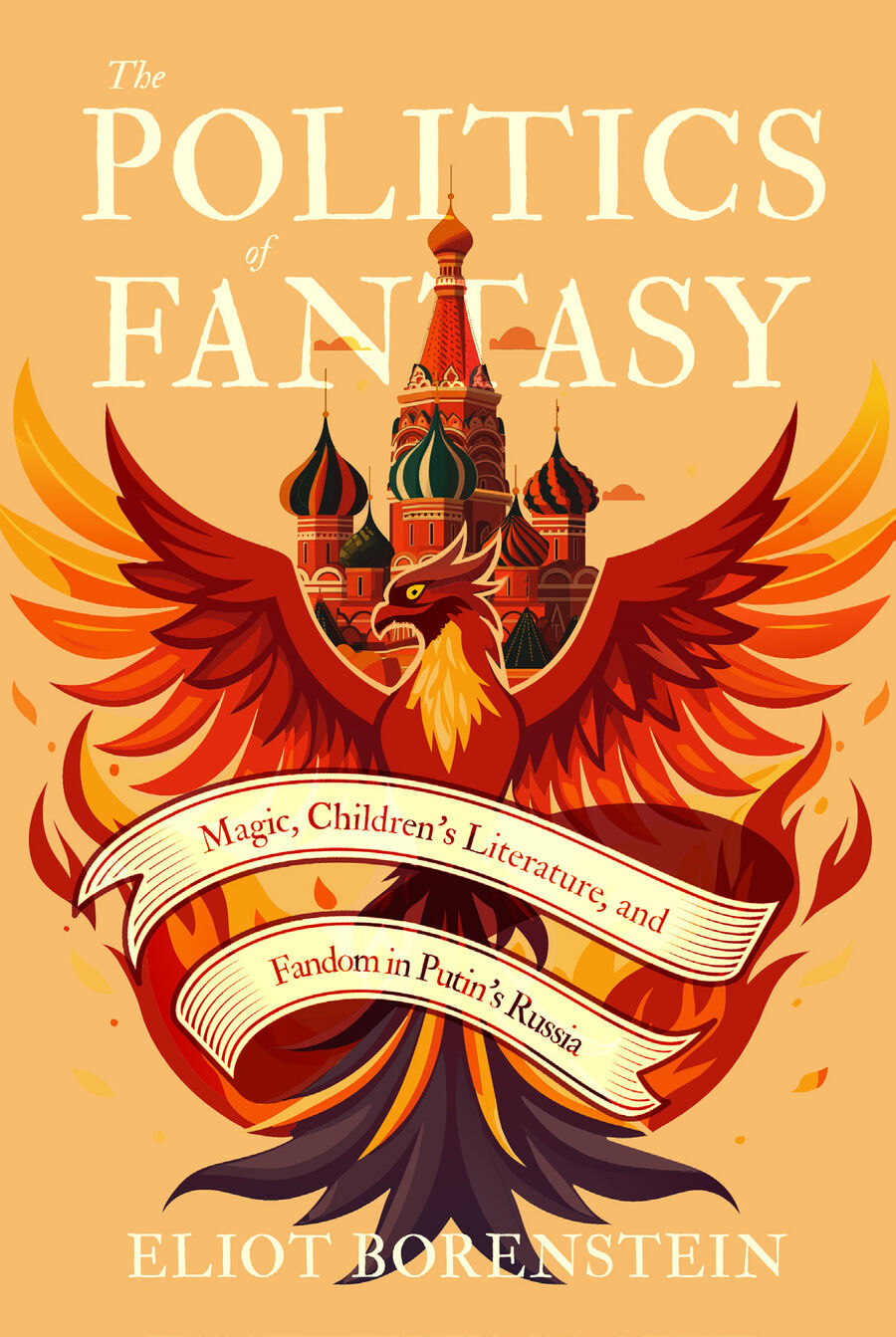
The Politics of Fantasy: Magic, Children’s Literature, and Fandom in Putin’s Russia
University of Wisconsin Press, 2025
193 pages
$32.95
Reviewed by Sam Parrish
In The Politics of Fantasy, Eliot Borenstein examines how the extended universe of JK Rowling’s Harry Potter series functions as a discursive framework in contemporary Russia. As is typical for Borenstein, whose previous research has examined Russian and American pop culture, the work is rigorous and accessible, lacking jargon and offering avenues for further research.
The first chapter describes Harry Potter’s belated entry to Russia in 1999: the Soviet Union had fallen less than a decade previously, and new free speech initiatives created an “almost surreal literary marketplace” in which previously banned books were newly available alongside new releases. Books were affordable and easy to obtain, but the vast majority of works for children were old classics familiar to elder family members. Harry Potter, when it arrived with multiple books already written and a movie series on the way, epitomized fears of a decadent West encroaching on Russian culture and values. Key to Borenstein’s argument is the near-simultaneity of the series’ book and movie releases in Russia, which shifted the cultural understanding of Harry Potter as a purely creative endeavor to a calculated marketing effort promoting potentially-occult work.
Fantasy as a genre in Russia is complex and contested. In the second chapter, Borenstein traces the history of fantasy and its generic reception across the Russian canon. Pushkin, often considered the godfather of Russian literature, drew from and reimagined classic Russian fairytales; but this fantastical literature gave way to the socialist realism of the USSR. In the years following the fall of the Soviet Union, fantasy was acceptable only when either grounded in reality or occurring entirely in a secondary immersive world that did not threaten to intrude on the “real.” The primary concern about children’s fantasy, Borenstein argues, comes from the belief that children’s literature is meant to set good examples, and many adults do not trust children to distinguish between truth and reality. Harry Potter, upon its entry to the unprepared Russian literary ecosystem, was thus new and frightening to an adult audience that neither knew nor trusted its world.
The simplest way to minimize fears of corrosive fantasies is to Russify them. Because Russia lacked a similarly successful series, and because Harry Potter embodied a theretofore-unseen transmedia success, Russian media desired an “answer” to Harry Potter. Borenstein describes a variety of Russian parodies, many of which are racist attempts to counter perceived political correctness, and many of which reveal legitimate criticisms of the original series. Of note is the Tanya Grotter series, which Rowling filed a lawsuit against to prevent its Dutch release; and Julia Voznenskaya’s Russian Orthodox YA ‘Christian fantasy’ novels, in which magic is real, Satanic, and must be resisted. These parodies, some of which became legitimate examples of the creative potential of appropriation, evolve from “copying a Harry Potter book as a specific object (text)” to “copying the embedded instructions for writing HP,” and, by extension, demonstrate how to create a franchise in the world of market capital.
In the fourth chapter, Borenstein distinguishes two distinct strains of Russian fandom: fan-videos and fanfiction, both of which owe their existence and proliferation to an Internet rise coinciding with Pottermania. Fan videos skew male, ranging from parodic translations to political interpolations of Russia/Ukraine relations onto Muggles/wizards. The culture of fanfiction, meanwhile, is a more tolerant, often queer space, with significant numbers of works in translation. The often erotic and explicit nature of fanfiction provokes the question of how one writes (queer) sex in Russian. Borenstein argues that erotic fanfiction creates a space to explore queerness and sexuality despite (and under) increasing state repression.
Chapter Five examines the Russian culture wars surrounding Harry Potter. Borenstein demonstrates that the flood of missionaries to Russia in the years following the fall of the Soviet Union created an environment in which anti-cult movements and Satanic panics proliferated, which in turn led to fears of Harry Potter’s potential Satanism. While this phenomenon was similar to contemporary panics produced by the US religious right, Borenstein argues that these fears and claims resulted from Russian political theology, which positions Russia as the bulwark against evil in a greater war against an antichrist embodied by the West. These complicated convergences and divergences from Western right wing thought, Borenstein claims, are emblematic of the contradictions within Russian conservative thought. This chapter crystallizes a recurring theme: the extension of the anti-American rhetoric that dominates Russia’s anti-Western ethos to the British Harry Potter series, a problem Borenstein acknowledges but does not examine in great detail.
The sixth chapter focuses on the 2004 novel Kids vs. Wizards and its critically-reviled 2016 film adaptation written by Nikos Zevras. Borenstein observes that this name is likely a pseudonym for a person or group that created a literary project promoting Russian superiority, the military, and the Orthodox church. Kids vs. Wizards, which infamously makes Harry Potter a transgender sibling of Hermione, depicts a hero tasked with fighting an obvious Hogwarts-analogue to protect Russia (and Russian Orthodoxy) from the “decadent values of the West.” Kids vs Wizards, Borenstein argues, is emblematic of the previous chapter’s culture wars, particularly when it is read as “part of a strategy to export American values and undermine the culture of the host country.” While Borenstein observes the irony of a trans Harry Potter in light of Rowling’s virulent transphobia, there is room to dive deeper into how Rowling’s conservatism complicates the “anti-woke” criticisms levied at the series by Russian conservatives.
The final chapter examines the comparison of Harry Potter’s Voldemort to Russian leader Vladimir Putin. Crucially, if Putin is read as Voldemort, there must be a corresponding Harry. As potential Harry-analogues, Borenstein suggests opposition leader Alexey Navalny and Ukrainian president Volodymyr Zelensky, both of whom have used the narrative framework of good vs. evil to rhetorically position themselves as Putin’s righteous opponent. In the case of Zelensky, Harry Potter both makes war in Ukraine comprehensible and allows Ukraine to position itself as the good opposed to Russia’s ontological evil. For Navalny, Borenstein observes, the comparison reveals the failures of understanding real life through fiction; in the series, we know Harry will triumph over evil, while in real life, Navalny died in a Russian prison.
Borenstein leaves the reader to question the utility of deploying Harry Potter as an interpretive framework in Russia. Is the ultimately optimistic happily-ever-after world and its values at odds with and/or alien to Russia? The Politics of Fantasy takes a broad approach to the Harry Potter phenomenon in Russia, providing a variety of subjects which could lead to further research, namely: the histories and politics of translation, the gendered dynamics of fanspaces, and the explicative power of erotic fanfiction in the Russian space. However, it’s worth mentioning that many of the arguments about the Russian conflict over Western cultural encroachment combine the US—Russia’s Cold War enemy—with the UK—Harry Potter’s homeland—in a way Borenstein acknowledges but largely elides. But on the whole, The Politics of Fantasy is a welcome addition to fandom studies and should prove useful to readers and scholars both within and without Slavic studies.