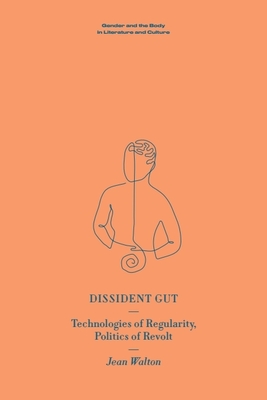
Jean Walton
Dissident Gut: Technologies of Regularity, Politics of Revolt
Edinburgh University Press, 2024
296 pages
$29.95
Reviewed by Sriyanka Basak
Jean Walton’s Dissident Gut is an audacious and generative intervention into Marxist, feminist, and biological thought, one that insists we take the gut and the labor of managing its outputs as seriously as we have taken sexuality, labor power, or the psyche. Refusing to treat digestion and defecation as mere metaphors, Walton shows that peristalsis is a historically-produced, deeply mediated site where class, gender, race, empire, and capital are worked through the body. The book’s wager is that “regularity” is not a neutral hygienic ideal but a key technology of biopolitical governance, and that the gut’s disruptions—its refusals, blockages, reversals, and stoppages—are crucial registers of revolt.
At the core of Dissident Gut is an argument for metabolic biopolitics. Walton begins with US border detention centers in 2019, and frames state violence as a “sustained programme of metabolic disturbance” where food, excretion, and hygiene are manipulated to reduce migrants to Agamben’s ‘bare life,’ stripped not only of rights but of access to the routines of toilet training and gut care that makes one feel human. The emphasis on constipation, diarrhea, leaking bodily substances, and clogged toilets reframes detention infrastructures as peristaltic choke points in a broader “geopolitical metabolic system” which further turns unwanted migrants into “refuse.” Sovereign power, she argues, thus acts at the level of the nervous system, staging biopolitics in the intestines as in the law.
Part One, “Macro-Peristalsis,” elaborates this complex systemic scene. Walton’s first chapter “Metabolic Rift and the Remedy of Faecal Recycling” revisits John Bellamy Foster’s ‘metabolic rift,’ to show how metabolism has quietly become a master model for thinking systems—from bodies and soils to cities and capital. Via Liebig, she retells the story of the broken loop of rural-urban nutrient circulation where human excrement once replenished nearby fields but polluted waterways. Walton sharply extends this narrative by centering women and faecal labor, drawing on Ariel Salleh’s ‘meta-industrial labor’ to insist that labor through housework, childcare, and waste handling are indispensable to any project of metabolic repair. Feminist labor politics becomes crucial to ecological restoration.
In “Faecal Habitus,” Walton reinterprets David Inglis’s history of excretion through a metabolic lens. Inglis locates a “bourgeois faecal habitus” in the clean-dirty binary, but Walton complicates this by demonstrating that bourgeois bodies are not simply repressed but regulated through “disciplinary training” and routine. Drawing on Foucault, she shows how defecation becomes subject to temporal control: when, how often, and by what means. The modern “faecal habitus,” she concludes, concerns “perfecting regularity, rather than separating the clean from the filthy,” shifting attention from disgust to regulation and normativity.
Chapters Three and Four form the book’s theoretical core, reframing metabolism as a site of exploitation and discipline rather than background processes. In “Marx’s Regulation of Metabolism,” Walton rereads Marx via Hannah Ardent’s distinction between ‘labour’ and ‘work,’ showing how Marx’s human figure depends on a tool-rich dialectic of organic and inorganic bodies, yet brackets gendered division of metabolic labor. Aligning with materialist feminists Timothée Haug and Roswitha Scholz, she exposes how capitalism’s outsourcing of metabolic reproduction to unwaged, feminized workers remains conceptually marginal though structurally central.
Chapter Four, “The Second Brain,” extends this analysis from political economy to embodiment. Using Michael Gershon and Josiah Oldfield, Walton treats the enteric nervous system as a hinge between physiology and biopolitics. Toilet training, the enteric “interoceptive perceptual apparatus” becomes calibrated to industrial time, domestic schedules, and classed/gendered norms, exemplifying how Dissident Gut persistently links micro-peristalsis to macro-politics.
Part Two, “Micro-Peristalsis,” folds the macro-theoretical framework into intimate case studies of early twentieth-century European women. “Unkinking, Streamlining and the Household Engineer,” traces how inner-hygiene culture, Sir Arbuthnot Lane’s colectomies, and Christine Frederick’s Taylorised Household Engineering converged in a project of peristaltic optimization. By moralizing constipation and transforming women’s bodies into industrial efficiency, Walton depicts how surgical streamlining and domestic engineering shared a fantasy of “unkinking” women, tying gendered identity to the ideal of a smoothly streamlined peristaltic modernity.
In “The Peristaltic Desiring-Machine of Miss Louise,” Walton reads Wilhelm Stekel’s case of a woman whose bowel movements depend on proximity to others at breakfast. After “warming up” with elaborate sexual fantasies, Miss Louise positions herself near those who provoke anxiety over odor, leading to peristaltic release. Stekel reads this as displaced sexuality, but Walton, drawing on Deleuze and Guattari, reframes it as an “olfactory-intestinal desiring machine” that reroutes both heteronormative sexuality and domestic femininity. Miss Louise’s dissent gut keeps her circulating through boarding schools and sanatoria, refusing to settle into the peristaltic labor of the bourgeois home.
Chapter Seven, “The Creative Devolution of Reverse Peristalsis” follows Rosa Strosmann, a Jewish working-class woman in London who vomits formed faeces—an event that fascinates physician Frederick Parkes Weber. Walton interprets Weber’s case notes and his obsessive marginalia as a “metabolism of scientific research,” mirroring constipated flows. She situates Weber’s debates about “hysterical,” alongside Sándor Ferenczi’s notion that organs themselves think, expressing “primordial psychic powers” through peristaltic reversals. Rosa’s anti-peristalsis documented through endless tests becomes a local metabolic rift—a gut-level thinking that unsettles the gendered, racialized medical gaze.
“Peristaltic Politics of a Suffragette,” brings the book’s biopolitical argument to a full circle. Walton reads Constance Lytton’s hunger strikes and forcible feeding as contests between feminist biopower and biopolitics. Walton tracks her vomiting and fainting as evidence that peristaltic failure reveals class disparities in prison treatment. She productively juxtaposes Lytton’s tactics with Gandhi’s satyagraha, linking gut-level “self-rule” to national swaraj. In doing so, she scales the intimate rebellion anticolonial politics, underscoring peristalsis as a foundational terrain of sovereignty itself.
The conclusion “Faecal Biopolitics in the Twenty-First Century,” returns to US contexts, pairing border camps with Catherine Flowers’s activism in Lowndes County, Alabama, where failing septic systems flood black yards. Walton reads these cesspools as instances of faecal injustice, where rural black communities are criminalized for inadequate sanitation while their waste is hypervisible. In juxtaposing this with civil-rights histories of sanitation workers’ strikes, these examples reframe environmental racism as faecal biopolitics that renders some communities’ excrement invisible and others’ oppressively omnipresent. Her call for “faecal activism” insists that access to decent excretory infrastructure underwrites any meaningful political life.
Dissident Gut’s major strength lies in how precisely it braids Marxist ecology, feminist theory, psychoanalysis, and medical history through the aperture of peristalsis. Its formal alteration between conceptual “macro” and detailed “micro” chapters exemplifies how theory and embodied practice must be read together. Her prose is lucid and balances analytic distance with respect for her subjects’ bodily experiences.
There are, however, some limits. Walton’s case studies privilege white metropolitan women, with racialized faecal politics (Lowndes County, Indian sanitation) appearing as codas rather than central analytics. Disability, likewise, remains tethered to hysteria rather than informed by crip theory. Nonetheless, Dissident Gut is an original and methodologically-generative contribution to environmental humanities, feminist theory, and critical theory. Its insistence that we treat shit, constipation, diarrhea, and hunger strikes as central to the understanding of biopolitics and capital. Walton equips readers with a vocabulary—‘metabolic rift,’ ‘faecal habitus,’ ‘dissident gut,’ and ‘faecal biopolitics’ for tracking how power moves through and is resisted by the viscera. In doing so, she opens an abolitionist and ecological horizon where peristaltic politics unites the bathroom, the border, and the body politic.