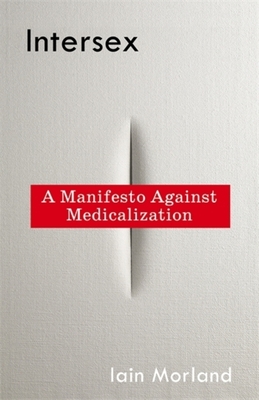
Iain Morland
Intersex: A Manifesto Against Medicalization
Columbia University Press, 2026
296 pages
$27.00
Reviewed by Kelvin Ronghan Qin
Intersex surgery has long been considered a standard medical ‘treatment’ for individuals born with atypical genital characteristics that do not align with the male-female binary. Iain Morland challenges this idea by attending to the embodied experiences of intersex individuals, revealing the entangled and often contradictory nature of intersex surgery and its lasting physical and psychological effects. Morland, an intersex scholar, also offers a reflexive and introspective analysis of intersex surgery by narrating his own surgical experiences. By delicately weaving analyses from different disciplines—psychology, philosophy, and queer theory—Morland offers much more than a critique of intersex surgery; this book dives into the fundamental logic and politics of the medicalization of the gendered body and endeavors to dismantle the medical infrastructure that constantly surveils, regulates, and alters intersex bodies.
In the introduction, Morland identifies their approach as a deconstructive critique of the gender-normative discourse surrounding intersex medicine. Gender normativity in intersex medicine is dependent on the binary categorization of gender (male versus female) and the presumed fixity and alignment of sex and gender. Genitalia, in this sense, becomes the primary biological marker by which an individual’s sex is determined and gender is dictated to correspond. Therefore, intersex individuals born with atypical genitalia are deemed “abnormal” since they cannot be accommodated by rigid sexual and gender categorizations. By altering their genital presence, parents and medical professionals coercively realign an intersex person’s primary sexual characteristics in the name of ‘care.’ However, Morland argues that this care could be toxic: the surgery can cause intersex individuals to feel defamiliarized from their own bodies, and experience haunting trauma during the coming-of-age process.
Morland unpacks and critiques the logic behind the intersex surgery by foregrounding the conceptual contradictions entrenched in the intersex medical practices: contradictions between what the surgery intends to achieve and what it actually produces.
One predominant contradiction of the intersex surgery is that the surgery produces a strange body rather than a normalized one. In Chapters One and Five, Morland interrogates the medical power of normativizing discourses, and emphasizes the objectification of intersex bodies in medical practice. For example, clitoroplasty is a commonly-practiced intersex surgery aimed at reducing or reshaping the clitoris to conform to normative expectations of female genital appearance. However, clitoroplasty carries great risks, including the potential loss of clitoral tissues and sensation, which are usually downplayed in medical discourse. In this sense, medical professionals hold absolute power over the intersex body, channeling normative cultural discourse to rationalize the surgery’s ramifications. As Morland highlights, norms and complications compose a conceptual frame within which medical professionals exercise their power: medical professionals frame a surgery’s goal as a necessary medical step toward normativity, and frame all deleterious and unexpected outcomes as mere complications to justify the surgery’s legitimacy.
Morland further interrogates the contradiction of the intersex surgery through a phenomenological perspective. By introspectively reflecting on their embodied experiences, Morland powerfully demonstrates how surgical interventions produce a self-entranged body. This phenomenological estrangement operates through sensory disruption rather than visual normalization. Intersex surgery produces a contrast of tactility within a single corporal body. As mentioned above, intersex surgery risks desensitizing the genitalia, which could result in the partial or total loss of tactility. The loss of genital tactility produces a stark disjunction between intersex individuals’ perception of the genital region and the rest of the body. Put differently, two rhythms of time occur simultaneously on the intersex body—the genital is trapped in a temporality marked by delay and interruption, while the other parts of the body follow linear time. This asynchronous embodied perception results in estrangement from one’s own body, as one loses control over it as an integral totality. The loss of control over the body has haunting psychological impacts on intersex individuals. In Chapter Two, Morland criticizes recent literature’s abuse of the ambiguous definition of trauma in interpretations of intersex surgery’s negative effects; Morland rigorously asserts that trauma is an integral and inevitable part of the medical treatment of intersex, disguised by the promise of gender ‘certainty.’
Trauma studies have become increasingly popular in the social sciences and humanities, but the conceptual definition of trauma has not yet considered the insights of intersex studies. Morland critiques the incompatibility of the common ‘deficit model of trauma’ and argues that trauma caused by intersex surgery is not merely a consequence of what has happened, but also an incapability of understanding what has happened. Intersex surgery is usually performed in infancy, based on medical professionals’ claim that children are especially sensitive to the appearance and functionality of their genitalia, as well as to others’ reactions towards their genitalia. Medical professionals assert that early intervention can minimize the psychological distress caused by the surgery because the surgery happens faster than they can consciously notice the change in their bodies. Therefore, the seemingly contradictory mechanism of presence (children are aware of their genitalia) and absence (children would be unaware of the surgery) functions cooperatively to rationalize the necessity and significance of intersex surgery.
Building on his critiques of the surgery’s contradictory logics, Morland adopts a reparative stance and engages queer theory, posing the question: What can queer theory offer to intersex individuals? In Chapter Four, Morland situates intersex in queer-theoretical discussions of pleasure and shame, indicating the incongruities and potential connections between these two disciplines. Morland challenges the centrality of sexual pleasure in queer theory as a form of “hedonistic activism,” suggesting that a postsurgical body cannot be accommodated in such corporeal discourse of desire and pleasure. To counter queer theory’s corporeal standpoint, Morland adopts David Reimer’s idea of ‘reaching,’ arguing that reaching is queerer than touching as it surpasses the limit of one’s body and resists a fixation on anatomy, grounding desire instead in movement, orientation, and relational becoming rather than in physical sensations.
Throughout this book, Morland offers a comprehensive, in-depth, albeit at times conceptually demanding, analysis of the contradictory logics behind intersex surgery. Through a deconstructive approach, Morland engages with interdisciplinary perspectives to expose how normalization is achieved not despite, but through, estrangement, sensory loss, and the haunting trauma caused by the medical interventions. Intersex: A Manifesto Against Medicalization thus constitutes a vital and acutely needed critique against medicalization not only within Intersex studies but also across medical humanities, Gender and Sexuality studies, and Critical Trauma scholarship.