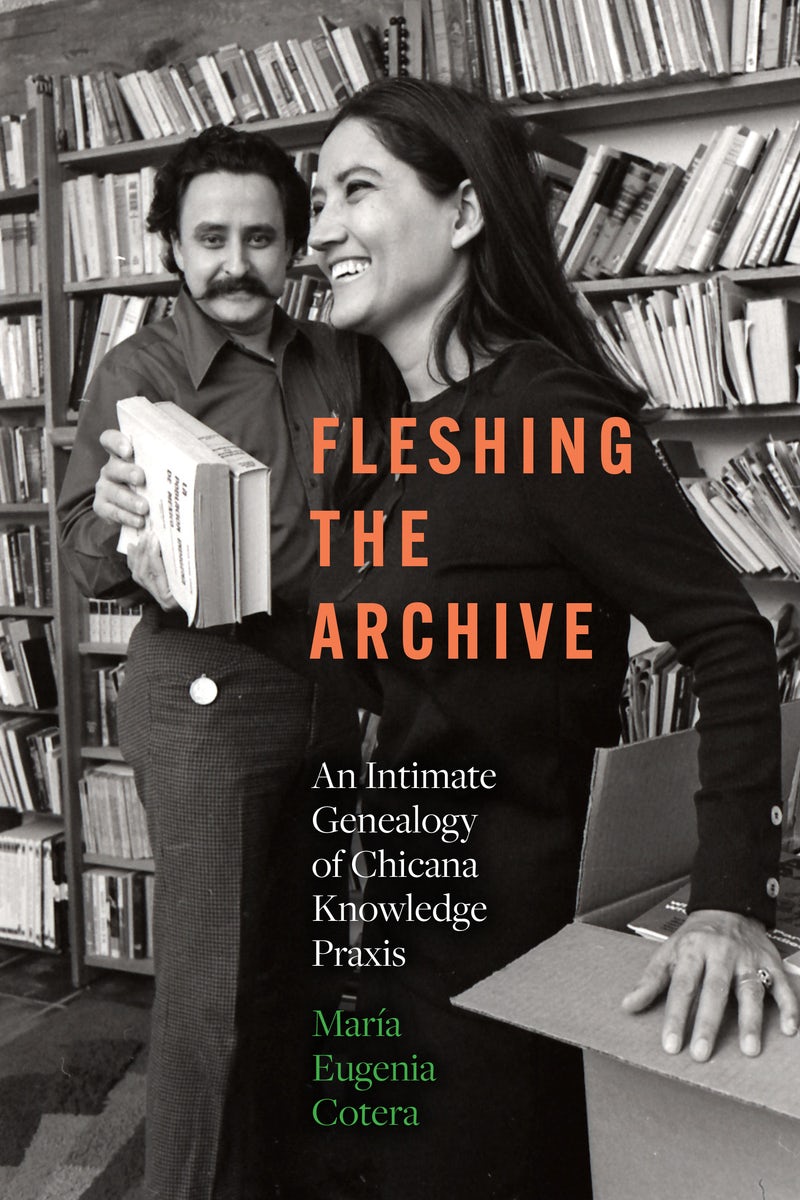
María Eugenia Cotera
Fleshing the Archive: An Intimate Genealogy of Chicana Knowledge Praxis
University of Texas Press, 2026
288 pages
$34.95
Reviewed by Elizabeth Martinez
María Eugenia Cotera’s Fleshing the Archive is a timely, poignant text that tells stories from The Chicana por mi Raza Digital Memory Project and Archive she launched in partnership with Linda García Merchant in 2009. Cotera narrates how this vast digital collection of documents, memorabilia, and oral histories by and from Chicana feminist activists of the late 1960s and early 1970s came to be, and she illustrates the resonances and echoes between contemporary Chicana knowledge projects and those of the Chicano Movement era. As Cotera explains, her own investment in archival preservation goes beyond “historiographic justice” and is grounded in her belief “that the futures interrupted, the paths not taken, and the truncated possibilities to which they bear witness remain relevant to our work as Chicanx feminist scholar-activists today.” In telling the stories of Chicanas in the Movement era, Cotera seeks to “offer not only an intellectual genealogy grounded in memory (both embodied and documentary) but also an invitation to reimagine our own work as scholar-activists through a dialogue with the past.”
Cotera’s book departs from traditional archival practices which treat archived materials as objects for scholars to discretely interpret. Instead, she presents an alternate methodology for archival work based on “centering collaboration, reciprocity, relatedness, and a shared obligation to the past, present, and future” which creates space “to write with the past rather than about it.” Thinking alongside Avery Gordon and Gloria Anzaldúa, Cotera engages in a radical memory project as she walks through a genealogy of Chicana knowledge praxis, and she rejects notions of objectivity. The book is rife with the personal. Beginning with chapters on her mother, Martha P. Cotera, and wading through an archive she is not only familiar with, but literally grew up surrounded by, Cotera displays how “fleshing the archive is a praxis of historical analysis that weaves together multiple strands of memory—the personal, the collective, the documentary.”
Chapter One finds the reader in the home of Cotera’s mother, Martha Cotera, as she encounters a living, breathing trove of materials “spreading tendrils of memory promiscuously across her office.” Marking a distinction from orderly, boxed, and labeled materials found in institutional archives, Cotera names her mother’s personal archive “unruly.” Citing Achille Mbembe, Cotera comes to the key question at the heart of her Chicanx archival praxis—how to intervene in institutional archives’ processes of extraction and erasure. She finds answers to this critical dilemma “through a praxis of archival recovery that centers relationship building and memory keeping.” She names this approach “a process of encuentro,” where encounters with archival materials necessitate exchanges in which knowledge moves in both directions between a scholar and a subject, asking us to “give up the ghost of narrative authority and reveal ourselves as only one interlocutor of an ongoing dialogue.”
The second and third chapters of Fleshing the Archive work together to, first, articulate the formation of Martha Cotera’s “tlamatini praxis” and, second, to analyze the relationship between the products of this praxis and the process itself. As Cotera engages in a historiography of her own mother, Chapter Two works to articulate how Martha Cotera emerged as an early archivist through her work as a librarian with a vision for “democratizing information.” The networks of knowledge Martha Cotera established were part of her “tlamatini praxis,” which sought to radically alter community access to information. Chapter Three then queries on the ephemerality of this kind of radical Chicana knowledge praxis and distinguishes it from the way academic institutions come to remember texts, or products of knowledge production, over resources. Cotera teases out the relationship between building resources and infrastructures and their products—writings—with the goal of “illuminating how the two are mutually constituted.”
The fourth chapter continues hunting for traces of Chicana knowledge praxis, transitioning to explorations of the origins of Chicana studies beginning with the Chicana Ad Hoc Committee within the Chicano Council of Higher Education. Starting with a mimeographed document of meeting notes, this chapter endeavors to expose otherwise invisible “labor and organizing networks” and “to chart an alternative map of the field that allows women to take center stage.” The chapter highlights a not yet widely enough recognized absence in histories of Chicano studies—the presence of Chicanas in these early articulations of the field. The chapter demonstrates Cotera’s Chicana knowledge praxis in action to underscore the type of historiographic work possible when there is a “dialogue between archives and embodied memory” that “allows us to read between the lines of existing narratives and challenge frameworks.”
The final two chapters continue demonstrating Cotera’s Chicana knowledge praxis in action with further demonstrations of the “encuentros” between subject and scholar through her musings on discussions with Anna Nieto-Gómez and Osa Hidalgo de la Riva. Cotera does not keep herself objective in her explorations of the modalities of knowledge praxis exhibited by Nieto-Gómez and Hidalgo de la Riva. She instead allows the archive to talk back and to “dramatically [shift] the grounds of historical interpretation” by consistently noting resonances and echoes between the work of the past and her work today. Cotera names these instances of resonances and echoes “moments of transformative recognition” that “thin the temporal boundaries between the present and the past.” This all aligns with Cotera’s final words shared in a Postscript titled “Chicana Futures—Past and Present” in which she makes clear that the series of narratives offered in Fleshing the Archive are meant not only to give those histories “greater visibility,” “but also to imagine ourselves otherwise.” The field of Chicano Studies is currently facing its own precarity and Cotera’s text, reflecting on the past, acts as inspiration “to take up the paths not followed.”