Summer Kim Lee
Spoiled: Asian American Hostility and the Damage of Repair
Duke University Press, 2025
232 pages
$34.00
Reviewed by Winona Guo
I’ve started to think of the book as a brown avocado, dripping in honey. For the Asian American artworks of interest to Summer Kim Lee in Spoiled: Asian American Hostility and the Damage of Repair are a little, or a lot too much, all indulging some irreparable post-ripe moment that’s been spoiling. Spoiled opens with the reaching brown and curved arm of Cato Ouyang’s Kicked Madonna, whose obtrusive ruination Kim Lee directs us to re-see as ravishment; the figure enjoys betraying the looker’s “wish to feel whole and healed.” I start to absorb Kim Lee’s question as this: What must be spoiled today? What about the racialized, gendered representation and aspiration of the Asiatic body must not be refused but rather allowed to rot, attuned to and even enjoyed in its decomposing?
The first answer may lie in the culturally-produced ideal of feeling Asian enough. Kim Lee irritates against this situation: Asian American artists are expected to heal, to “cathartically confess” and recuperate the feeling of wholeness “by way of claims to a legibly minor, resistant, radical Asian American subjecthood.” Her theoretical ambition further emerges in a post-Kandice Chuh-and-others moment of ‘narrative plenitude’ marked by the ‘constitutive ambivalence’ of Asian Americanness itself. Kim Lee’s mostly-millennial artists clamor for life amidst these ruins of Asian America. The waste and excess of the spoiled, the “squish and stretch of the butchered chicken’s skin” in Chapter Three’s reading of Mila Zuo’s Carnal Orient resound a morbidly far cry, for instance, from the “stone bread” that Sau Ling Cynthia Wong canonically read in 1993 as the Asian American mouth for Necessity rather than Extravagance.
Kim Lee locates the “spoiled” alongside Cathy Park Hong’s ‘untelegenic’ minor feelings, José Muñoz’s ‘owning the negation,’ and Eve Sedgwick’s ‘shorn parts;’ she argues that it is in the “oozing wound”of Asian America that we might find possibility alongside the critical process of deidealizing and deforming its subject formation. This seems related to this sense, or (non)sense, throughout Spoiled, of the distant body, the wound of the inability to reach her (the figure of the spoiled: the “polymorphously perverse girl”). In Chapter One, Kim Lee reads the asociality of “staying in” through works by Mitski, Patty Chang, and Ocean Vuong; in chapter 3, on “cold leftovers,” she enters David Henry Hwang’s M Butterfly through the sensation of coldness, privileging thermal sensation where other contemporary Asian Americanist scholars have theorized inscrutability, refusal, opacity, deadpan, disaffection. This is called “Asian American hostility” in the subtitle, but what’s unsaid is how this hostility nearly always seems to occur in order to protect some other kind of warmth. Let’s not forget how deeply desiring Ouyang’s arm appears, the eros possibly related to its wound, and the Anne Sexton poem which inspires its title:
You say it is angry.
I say it is like a kicked Madonna.
Its womb collapses, drunk with its fever.
We breathe in its fury. (1981)
In Chapter Four, “Injured Enough,” the wound question rearticulates itself as one of racial injury. Artist TJ Shin asks Kim Lee at their studio at UCLA, “Are you sensitive to smell?” Kim Lee interprets this as a question of care, analogous to “Who hurt you?” arising from Shin’s awareness of their own capacity to harm. She says no; Shin lights the incense of Untitled (100 days of solemnity) at their feet. Kim Lee calls these connections “the wounds of analogy that spoil the space, them, their work, and me,” that is, referring to the spoilage which occurs when Asian bodies are put in analogy with “something else that has (already) been destroyed.” In works by TJ Shin and Res Fan, milk drips from a breast onto shattered porcelain and aqua resin molds of an ex-lover’s breasts stack on top of one another. Kim Lee, in her analysis, takes up Chuh’s question, “Asians are the new… what?” to ask what sensorium of racial injury emerges for an Asian American subject serially understood through being compared to something else—something ruined.
Chapter Two, meanwhile, takes us across Wu Tsang’s oeuvre and LA’s “pollution-pink sky” to ask how we may embody or “host” the voices of others, “where a quotation begins and a body ends.” Here, I am drawn to the difference that Kim Lee seeks, following Barbara Johnson, between “using people” and “trusting people.” The difference seems to be that Wu Tsang also puts her own body on the line, as a student of the archive rather than a filmmaker offscreen like Livingston in Paris is Burning (1990). This is, following Gilles-Peterson, also “a site of queer theory’s spoilage,” an injunction for queer theory to remember its own desire for repair—the history and the risk of extractive harm—alongside its interdependency with trans women of color. Somewhere in Tsang’s huddle of wants and the hitches between lip-sync and pre-recorded voice, Kim Lee listens too for the deepening maladjusted resonance of the trans ‘terrible we,’ of Cameron Awkward-Rich.
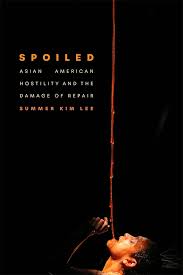
But it is in the coda where I locate the book’s heartbeat. Two times Kim Lee experienced the performance HONEY, where golden globes of honey drip into Julie Tolentino’s mouth for three hours. This image of excessively sweet want is all Kim Lee; in her Aries-child desire for cosmological return to a Ptolemaic order wherein the world does still revolve around her, she finds too her insistence on the wants of others, her belief that the Asian body may be something more today than the job of facilitating repair. Kim Lee wants, and perhaps for herself too, that girl who is willing to taste her neediest want—the “inappropriate quantity” of it—risking entry as such into the spoils of everything she’s idealized and known.