Isabelle Thuy Pelaud, Lan Duong, and Viet Thanh Nguyen, editors
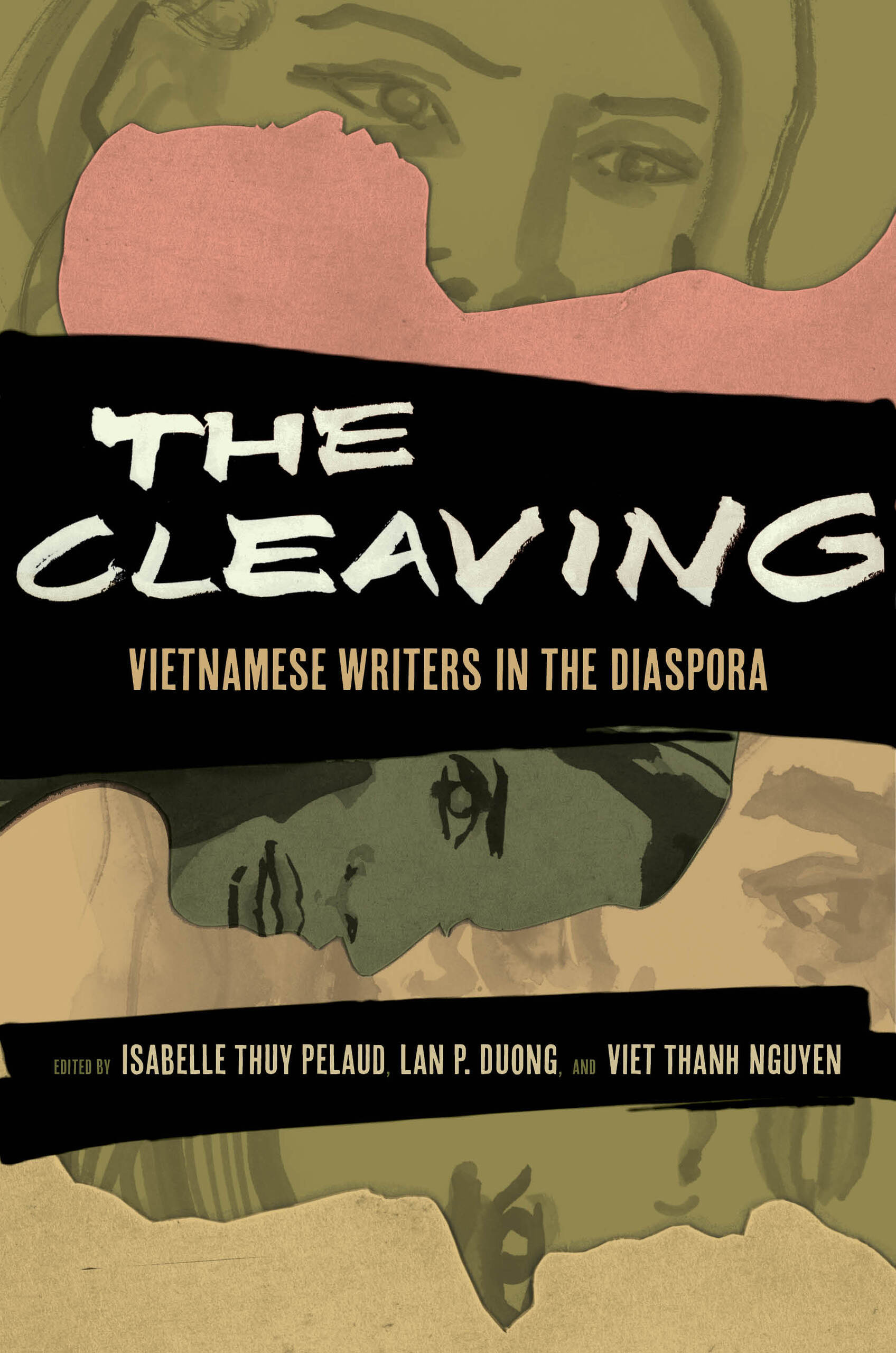
The Cleaving: Vietnamese Writers in the Diaspora
University of California Press, 2025
264 pages
$24.95
Reviewed by Kevin M. Gibbs
Growing up in the San Francisco Bay Area in the 1980s, Viet Thanh Nguyen had trouble finding literature that reflected his experience as a Vietnamese refugee. So, when he opens The Cleaving by stating, “It is an incredible moment to be a Vietnamese diasporic writer,” one senses Nguyen’s own awe at the representational progress made over the last four decades. In many ways, The Cleaving serves to recognize and celebrate the success that Vietnamese diasporic writers have achieved. The very shape of the volume is testament to that success: it consists of eighteen dialogues between thirty-seven writers of the diaspora (the last dialogue is a three-way epistolary) and is edited by three notable Vietnamese American academics: Isabelle Thuy Pelaud, Viet Thanh Nguyen, and Lan P. Duong. The Cleaving reminds readers of the impact that these writers have had on culture, both in America and overseas. Indeed, the cultural output of the Vietnamese diaspora is notin any way complete, nor has this output achieved parity with white accounts of the war, but The Cleaving neverthelessserves as a record of the growing influence of Vietnamese writers.
In his introduction, Nguyen makes two assertions regarding the importance of the volume. First, The Cleaving rests on the belief that “What writers think about their work and their place in society is relevant and helpful to know.” Second, while Viet Thanh Nguyen concedes that “Only social and political movements, motivated by utopian dreams, can abolish these conditions of mass inequity and injustice,” he simultaneously makes an argument for the importance of art: “literature and writing, storytelling and art, can illuminate the way.” In other words, art has a politicalfunction.
Yet the relationship between art and politics is but one of many tensions that the writers in The Cleaving struggle with. We exist in a moment of reactionary politics, where books that depict minority experiences face calls to be banned from public libraries and schools, where the university cultural studies departments that analyze non-white literature are silenced and shuttered, and where, simultaneously, the flag of the Republic of Vietnam was waved above the US Capitol during an attempted insurrection. The Cleaving is situated in these cultural touchstones and movements: between the progressive impulse behind Asian American identity politics and the anticommunist beliefs of those Vietnamese immigrants who fled the Socialist Republic of Vietnam, between the contradictory demands to assimilate yet remain permanently foreign, between the myth of Asian American exceptionalism and the possibility of panracial solidarity. If, as Viet Thanh Nguyen suggests, “It is an incredible moment to be a Vietnamese diasporic writer,” then it is so in part because of the ways that writers of the diaspora tangle with these contradictions.
The volume is loosely grouped into five categories, where the first, “On Violence: There and Here,” responds to the violence inflicted in Vietnam and abroad and its lasting trauma. Here, violence and trauma are framed not just as materialfor writing but also, more importantly, provide a motivationfor writers. The next two sections engage directly with the politics of identity. “Authorship and Authority: The Americas and Việt Nam,” questions the premise of the volume itself: what does it mean to be a Vietnamese writer? As the editors conclude in their introduction to the second section, “to be Vietnamese is not a racial condition but rather an affect.” In other words, it is not an identity but an identification, a choice rather than a constraint, one that provides an opportunity for solidarity and the coalition-building that this volume celebrates. Yet identity is of course not limited to ethnicity. The third section, “Writing Feminism and Disobedience,” notes the silencing strictures and expectations that Vietnamese American women writers are subject to: those of the model minority, the patriarchal Asian family, and the immigrant-as-polite-houseguest unwilling to make a fuss. Vietnamese American women writers are subject to pressures from within and without the community that delineate how a ‘good’ Asian woman should behave.
As the volume continues, the section titles become more vague, even as their critiques grow concrete. The fourth section, “Representation, Writing, Reception,” deals directly with the role of history and the ethics and burden of cultural representation, and in many ways parallels the section on authorship—can craft exceed identity, or will ‘Vietnamese-ness’ always overdetermine the reading of a text? André Dao, for instance, distinguishes the ‘colonialist’s eye’ from the reading practices of those who “engage with the decisions made about voice and narrative and sentence and structure and image and so on—that is to say, to treat it as literature rather than as some anthropological artifact.” He asks for the bare minimum: to be treated as a writer and not like the Igorot people exhibited at the 1904 World’s Fair. The fifth and final section, “Form and Future,” ties together queerness and imperial wars, applying the lessons of the Vietnam War to the American empire as a whole. As T.K. Lê asks (and answers), “What do traumatizers do? They frame our suffering in such a way that excuses them from the violence they cause. They omit facts. They reword history books. The gymnastics of logic, the twists and stretches, that the US government has made to justify its presence in Việt Nam is so absurd, and yet it works.” As a response to those historical elisions, Matt Huynh highlights the importance of “memory and storytelling” as twinned ways of approaching the truth—tellingly, the very tacks that the contributors included in this volume have taken.
Isabelle Thuy Pelaud, in the Conclusion, “On Being a Writer at the Border,” asserts that “[Vietnamese diasporic artists] engage with the long durée that is colonialism and imperialism and its aftereffects, as much as they wrestle with grief, longing, and the ghosts of the present.” By invoking that long durée, Pelaud considers how The Cleaving, whilecentered on the Vietnamese diaspora, speaks to more universal experiences. The Coda, authored by all three editors, explains the impetus and urgency behind the volume. They are motivated not only by a commitment “to the identities and cultures of the Vietnamese diaspora” but also “to the political urgency of recognizing our solidarity with others who have been displaced, erased, marginalized, and shattered by the same forces that produced us as refugees and immigrants.” ‘Radical solidarity,’ the term that they use, provides a way to link the history of Việt Nam to more contemporary postcolonial struggles. As the editors note, there are parallels between the American war in Việt Nam and “American support of Israel’s war in Gaza” only made visible through an understanding of both.
In the final dialogue of the volume, Paul Tran argues that “the future of Vietnamese writing throughout the diaspora seems to me a future of invention and imagination, reinvention and reimagination, dreaming and dreaming again.” Even as The Cleaving serves as a retrospective, a recounting, and an exhibition of thirty-seven writers of the diaspora who have achieved popular success, it more importantly looks toward the future, to ‘radical solidarity’ and the possibility of emancipation on the horizon: a possibility imaginable only through art, broadly conceived.