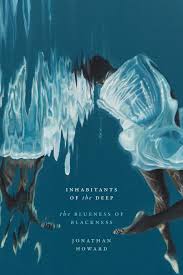
Jonathan Howard
Inhabitants of the Deep: the Blueness of Blackness
Duke University Press, 2025
352 pages
$34.99
Reviewed by Aden Morvice
Jonathan Howard begins his cultural study by grappling with the indeterminacy of beginnings for blackness. He takes readers through the National Museum of African American History and Culture in Washington D.C., down an elevator into the history exhibit. The history exhibition’s “introductory apparatus” is the Middle Passage and the words of Olaudah Equiano, whose personal narrative anchors Howard’s study. In his introduction, Howard acknowledges both the academic tendency to frame the Middle Passage as a historical origin for blackness as an ontological position and the role of The Interesting Narrative of Olaudah Equiano (1789) in drawing the Middle Passage out of “the archive’s deafening silence.” Yet Equiano does not occupy an uncontested place in the historical record. Recent biographical scholarship has concluded that Equiano was likely born in South Carolina, and that his eyewitness account of Africa and the Middle Passage was fictional. Howard, though, welcomes Equiano in his archive. Equiano is one of many black writers long regarded with suspicion, and Howard recognizes the value of “truth” in potentially-fictional accounts of black experience. Howard opens his work by wading into the contested waters of authenticity and truth, and reassessing the question of origin’s sedimentary foundation.
Howard’s Inhabitants of the Deep: the Blueness of Blackness is an ecocritical study that affirms ‘the deep’—the sea, the cavernous depths, the earth’s vast and unownable other—as the “diffuse subtext of black literary and expressive culture.” He borrows his title from Equiano’s description of the enslaved Africans on the Middle Passage who either jumped or were jettisoned from slave ships as those who “happily” inhabit the deep. Howard interprets this figuration of the sea to describe the “habitable elsewhere” crucial for understanding blackness and black life. Shifting away from Afropessimistic understandings of “social death” as blackness’s foundational affect, Howard argues that “blackness which dawned in the oceanic encounter of Middle Passage set flowing an experiment of human inhabitation…as black ecological life hailed by a blue planet.” His study tracks the persistent turn to water in black letters and art.
Many texts thread through Howard’s six main chapters, chief among them Equiano’s The Interesting Narrative. In Chapter One, titled “Deep Humanities,” Howard presents the Atlantic Ocean as a site of deep-sea encounter between Europe and Africa. Beginning with a colonial understanding of “land” as both a place and a verb, Howard separates the deep from terra firma, setting whiteness on land in opposition to the blackness of the deep. The colonial desire to traverse, understand, and dominate the ocean represents a Eurocentric relationship to water that is only legible in terrestrial terms. Early modern European settlers’ failure to extract and privatize the great deep leads to a “doubling down on terra firma and the stand-your-ground subject.” A“terrestrial bias” and desire for ownership are, for Howard, defining features of whiteness and colonial humanism. Despite more than two-thirds of the Earth being made of water, whiteness insists on a model of planetary ownership the deep renders impossible. This stands in contrast to blackness’s relationship to the deep—the habitable sea of the Middle Passage, and “the gathering and fellowship of this black and blue ecclesia.” Equiano’s narrative introduces a willful devotion to water, sustained even amidst enslavement. The deep becomes something to yearn for against the burgeoning antiblackness of the land. Equiano thus recognizes the deep-sea “inhabitants” as happier than him aboard the slave ship. Howard closes his chapter by noting that “by undertaking the awful labor of conceiving and improvising human life absolutely at sea, what the Africans bereft of the middle actually managed to do was live.”
His second chapter, “Deep Study,” turns to a white-authored text: Herman Melville’s famously watery Moby Dick. Melville’s ship the Pequod is crewed by a diverse, largely non-white cast who, as inhabitants of what Howard calls the “dark side of earth” and the “dark side of mankind,” prefer the ocean to the land. Howard acknowledges the challenge of drawing an analogy between (anti-)blackness and the environment before making the case for the oceanscape as a site of blackness’s eschatological imagination, particularly in Moby Dick. The central figure of this chapter is Melville’s black shipkeeper Pip, who at a pivotal moment willingly jumps overboard. Howard considers Pip American literature’s most reliable witness to the fact that deep water and drowning are not the same thing. The close read of Melville’s novel is refreshing in its contextualization of this canonical American text alongside the experience of black life on the Middle Passage. “Deep Study” deserves a place on every syllabus invested in an ecocritical study of Melville and Moby Dick.
Howard makes substantial contributions to sensory studies across the book’s remaining chapters. Chapter Three, “Deep Voice,” attends to the final words and noises of the deep inhabitants as an act of reclamation against the systemic silencing of black folks in historical archives and cultural memory. The black literary tradition’s struggle to represent the experience of blackness mirrors the silence imposed on the deep inhabitants by imperial history. What might become possible by studying the voices of those figuratively and literally “drowned out” by history? And how might one bear witness to a people long shrugged off as mere casualties of the centuries-long transatlantic slave trade? Howard continues this work of detection in Chapter Four, “Deep Imagination,” which listens for blackness beneath the surface. Here, he refers to the “creative activity” of black thought and storytelling as the “material imagination of blackness,” a concept with considerable generative potential for future literary discourse. Chapter Six, “Deep Vision,” turns to the (im)possibility of an eyewitness account of those in the deep. He turns to the contemporary figure of Mamie Till-Mobley, who insisted on an open casket for her son Emmett after he was lynched in 1955. What might be possible when we disrupt expectations of mutual recognition by bearing witness to black folks who, no longer of the land, have passed into the realm of testimony and iconography?
Howard’s archive is expansive and well-curated, including the long-poem Zong! by M. Nourbese Philip (2008), a photograph of Dizzy Gillespie playing the trumpet underwater (1958), August Wilson’s play Gem of the Ocean (2003), the physical gravesite of Emmett Till (visited 2022), and W.E.B. DuBois’s landmark sociological text The Soul of Black Folk (1903). In the hands of a less skilled academic author, all of Howard’s threads could easily unravel. His chapters are eloquent and sure-footed as he rides the waves of these diverse texts to create a genuinely impressive monograph. I turn, finally, to Howard’s chapter five, “Deep Life,” in which he reads Wilson’s play Gem of the Ocean as an imagination of what life of the deep may look like. In his close reading, he recognizes the relegation of black folks to the outside of modern society and finds it wanting. He asks: what if “blackness is not only outside of the antiblack world but in the Earth? And what if, when the final flame [of social life] burns out, we will still be black […] what if what survives the fire [of social death] is black life?”