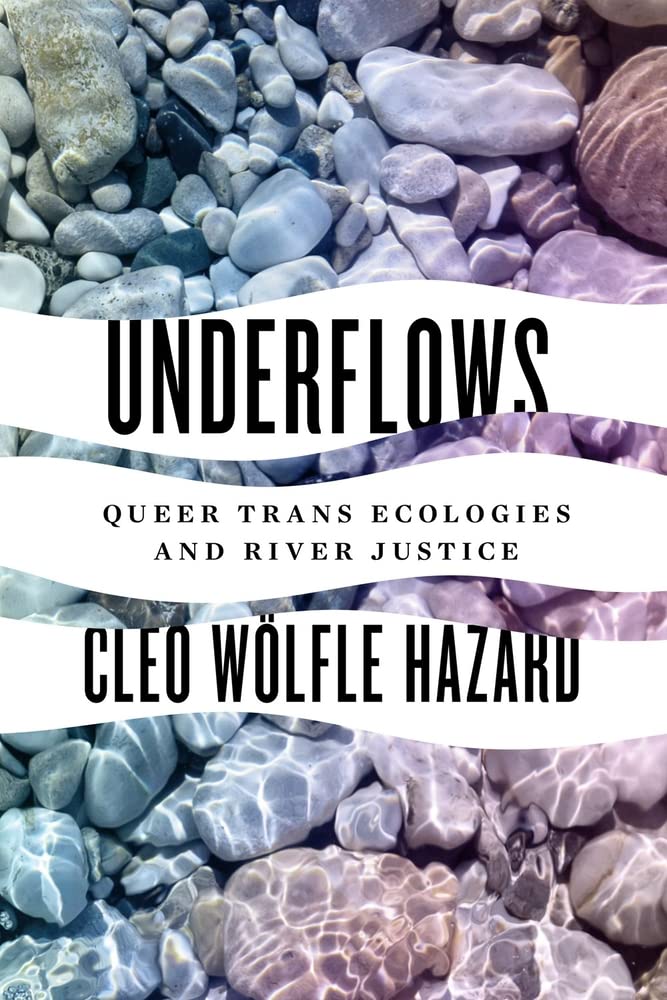
Cleo Wölfle Hazard
Underflows: Queer Trans Ecologies and River Justice
University of Washington Press, 2022
312 pages
$30.00
Reviewed by Isaiah Frost Rivera
A multidisciplinary and multispecies exploration of our collective relationship to land and water, Cleo Wölfle Hazard’s Underflows: Queer Trans Ecologies and River Justice is a singular achievement in ecological study that highlights critical insights from Indigenous, feminist, and queer studies and their shared investments in “the intersecting challenges of climate change, settler-colonial legacies of environmental harm, and gendered violence.” Framing his book through rivers, a site of everyday life and a symbol of political fluidity and transformation, Wölfle Hazard utilizes “underflows,” the hyporheic zone beneath a river’s visible currents, to highlight the unseen forces undergirding “settler-colonial river management” as well as “the mainstream ecology, hydrology, social science, and economics that shape it.” Aligned with decolonial Indigenous Studies methods and theories of relation with the natural world that tend to be excluded and undervalued by Western environmental science and water management entities, Wölfle Hazard articulates “a politics of solidarity with water and rivers, by understanding them as willful, unruly, feeling, acting beings,” presenting underflows as “a practice, an orientation, and an invitation to attend to hidden flows and their movements, excesses, and relations.” Centering queer and trans thought, Wölfle Hazard also utilizes the term “queer trans,” which includes LGBTQ+ individuals who may alternatively identify as one, the other, or both, positioning
Underflows within an expansive collective “which celebrates genderfuck and trans brilliance and includes queers who don’t identify as trans but embrace multiplicity.” Thus, queer and trans underflows contribute to the ever-evolving field of “queer trans feminist ecology,” challenging river scientists, cisheterosexual people, and settlers alike to be just as adaptable and expansive in their relations to ecologies as Indigenous people and, thusly, their queer trans allies.
Underflows is divided into six chapters, bookended by an introduction, that defines key terms and foregrounds the book’s methodology, and an epilogue that presents the author’s next project with the Karuk Tribe. Each of the main chapters is preceded by a brief “underflow” section featuring anecdotal or speculative vignettes that frame the analyses that follow.
The first four chapters and their preceding “underflows” complicate and expand upon Wölfle Hazard’s method, highlighting concepts in ecological and hydrology, queer and trans embodiment, and grief. In “Underflow 1: Hyporheic,” Wölfle Hazard offers an expanded definition of the titular hydrological zone from
which his method derives its name, explaining how, despite their outsized influence on ecosystems, underflows have only recently gained prominence in Western water law and management. Expanding on this theme of hydrology and governance, Chapter One, “Thinking with Salmon about Water,” focusses on Wölfle Hazard study of Salmon Creek, outlining what he terms the “water imaginaries” that shape the interests of settler and Native communities through the lens of salmon and beaver ecologies. Here, Wölfle Hazard pulls from ethnographic field interviews and archival resources to conceptualize water imaginaries in which the multispecies needs of humans and other-than-humans “reveal matters of concern and care that animate conflicts over how to govern water in a given place and how to care for the land, water, and species.” The next underflow/chapter duo shifts to the personal, highlighting Wölfle Hazard’s complicated experiences as a queer-trans field scientist. In “Underflow 2: Being in the Field,” Wölfle Hazard recalls his experiences doing
fieldwork with his cisheterosexual colleagues before publicly identifying as trans, locating the field as a space of potential exclusion but also one in which “gender as a social category receded some” and “we were all just muscle and skin, adrenaline, pain, and sensory overload.” This dichotomy directly foregrounds Chapter Two,“Being in the Field,” wherein Wölfle Hazard pulls from Gloria Anzaldúa’s notion of “autohistoria” to further
highlight his experiences in the field, revealing the ways queer-trans-feminist field workers can, like the Indigenous peoples who precede them, forge new epistemological relationships to grief, space, and time via an attunement to “interspecies relations” between humans and other-than-humans.
In “Underflow 3: Trans Thought as Latent to Manifest Destiny Logics,” Wölfle Hazard provocatively compares the uncontainability of trans bodies to that of bodies of water, drawing a conceptual link between the transgressive nature of underflows and trans identity to conceive of a “trans river embodiment,” in which human and other-than-human needs align in resistance to the settler colonial logics of river control schemes.
Extending this analogy, Chapter Three, “The Watershed Body: Trans and Queer Moves in Beaver Collaboration,” returns to beaver relations to animate the overlapping ways in which humans and other-than-humans cross literal and symbolic boundaries that challenge and disrupt the fixed nature of settler-colonial regimes of river management and meaning-making. Establishing a “transspecies alliance with beavers,” Wölfle Hazard maintains the need for a decolonizing approach to river governance center in queer trans and Indigenous epistemologies attuned to other-than-humans and their ecological world-making practices.
“Underflow 4: Making Queer Kin and the Queer Field” further expounds on Wölfle Hazard’s underflow methodologies as “for and by queers—including queer trans people and heterosexuals who have made relations with queer communities” as well as “resolutely transdisciplinary (and undisciplined) scientists” whose work exceeds the boundaries of the natural sciences. Recalling his own PhD training, Wölfle Hazard heralds the lab he worked in for centering queers, gender-dissidents, and people of color in ways that contributed positively to their collective engagement with the natural world. This notion of a queer ecological method shapes Chapter Four, “Unchartable Grief: Scientists Grapple with Extinction Politics,” in which the insights and methodological experiments of Wölfle Hazard’s previous chapters converge. Here, the author returns to salmon to argue in favor of a grief-centered fieldwork approach that acknowledges one’s affective relationship to other species and their extinctions by mirroring radical Black, Indigenous, and queer politics that “practice care in the face of state violence, channeling love but also rage and grief.”
“Underflow 5: Affects and Ecopoetics Practice,” the longest of the “underflows,” asserts field writing as an ecopoetic practice that centers queer and trans affect and subjectivity within the normal sciences, one which offers “a queering of method and an interrogation of relation by people who are together in the field.” This ethic fundamentally shapes Chapter Five, “With and for the Multitude: Cruising a Waterfront with José Esteban Muñoz,” which shifts Wölfle Hazard’s analytical approach to urban waterfronts, namely the Duwamish River in Seattle. Here, Wölfle Hazard engages explicitly with Muñoz’s notion of a “brown commons” to imagine how radical politics of collectivity, particularly in light of the COVID-19 pandemic, can foster interracial and cross-species solidarity in the face of environmental injustice in an urban environmental context. The final and following underflow section, “Underflow 6: Field Writing with the Brown Commons,” rounds out this discussion with an ecopoetic description of the Duwamish River, followed by an epilogue outlining Wölfle Hazard’s next research project on the Klamath River.
Theoretically dense and methodologically rooted, Underflows offers an ambitious, complex, and insightful contribution to environmental studies, one that is in good company with the cross-disciplinary efforts of Black, Indigenous, and feminist studies scholars to imagine otherwise ecologies in the face of climate crisis and the deep-seated legacies of settler colonial.