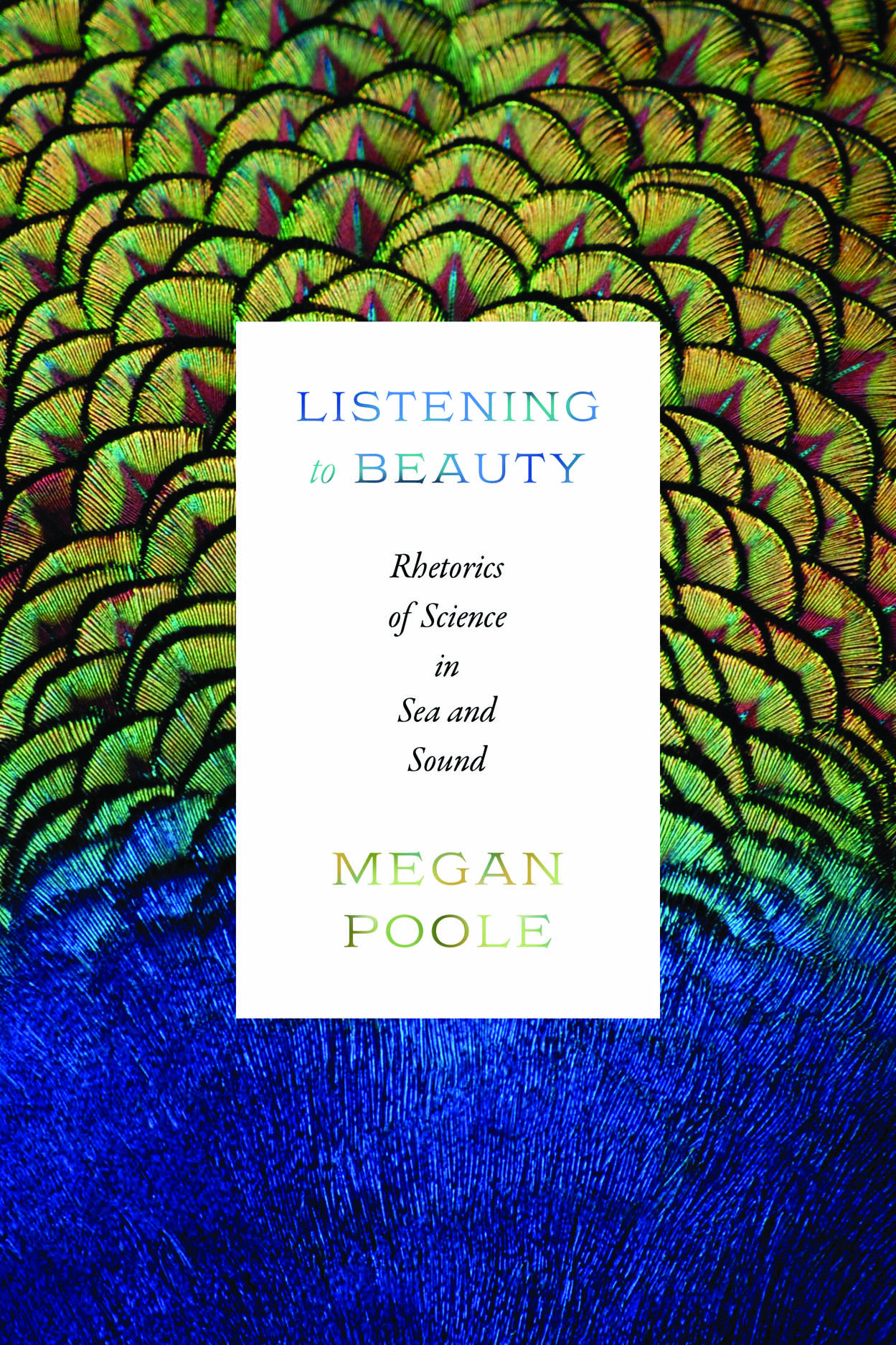
Megan Poole
Listening to Beauty: Rhetorics of Science in Sea and Sound
The University of Chicago Press, 2025
208 pages
$30.00
Reviewed by Mia Bañuelos
Few books compel an audience to linger with and listen to their environment in new ways far after putting it down. Megan Poole’s Listening to Beauty asks us to do more than just listen—Poole asks us to witness, to be active participants in the world around us by considering beauty in ways we haven’t before. Poole does more than uncover the exigency of considering nature and “nonhuman kin.” She describes “punctive listening” as a framework that presents beauty as a rhetorical method for understanding how we listen, witness, sense, and know. Across eight interviews that she conducted with scientists, Poole argues “What is important here is that whether we are seeing or hearing, we are always listening—punctively, deeply—to our environment, engaging with our environment affectively and methexically. Because, according to [Susanne K.] Langer, ‘nature speaks to us, first of all, through our senses.’” Poole challenges her audience not only to let nature speak to them through these senses, but to orient their senses and listening practices toward nature.
Chapter One, “Nature’s Punctum,” establishes the book’s theoretical foundations by highlighting the work of Susanne K. Langer, a lesser-known philosopher who examined the role of aesthetics in science. Langer lingers in the text, as Poole uses Langer’s work to provoke the scientists she interviews to think beyond the discursive, and instead, foreground affect and feeling. Langer’s theories argue that going beyond discursive and “presentational” symbols pushes scientists to better understand their relationships with their subjects. As Poole argues, Langer’s “broad definition of the symbol aids in this process of negotiating how aesthesis emerges from matter, how feeling emerges from nature.” For Poole, Langer’s “felt life” frames Roland Barthes’s notion of the “punctum:” the component of a photograph that arrests a viewer’s subjectivity. The relationship between these two theories helps Poole describe how one might listen to beauty.
In Chapter Two’s “Punctive Listening,” Poole interviews Katy Payne, a zoologist known for releasing the vinyl album Songs of the Humpback Whale alongside Roger Payne and Scott McVay. Poole argues that Payne’s work is an example of “punctive listening,” a “method of empirical inquiry in which rhetorical resonance with subjects is prioritized over discursive knowledge about those subjects, in which meaning derives quite literally in a different sense, in a sense in which feeling is fully articulate.” Poole argues that “Payne’s simple observation allows her to feel the evolutionary connections between her own being and the vitality flowing through the other beings in her environment.” Payne does not claim to be a scientist; rather, she argues that her observations of whales are music that emphasize listening. Her observations, then, catalyze a relational and participatory action that can be likened to witnessing. Payne, similar to Langer, lingers throughout the book; Poole notes that Payne’s legacy is felt by many people who recollect the first time they heard the whale songs.
Shifting to Payne’s Elephant Listening Project at Cornell University, Chapter Three’s “Extractive Listening” disputes the Western scientific framework that privileges interpretation over mere reception. Payne’s elephant communication research allows Poole to push against extractive listening—or, as Dylan Robinson calls it, “hungry listening”— which privileges colonial forms of knowledge. Punctive listening asks a researcher not only to shift their grammar but also to shift their sense of time. In this chapter, Poole interviews Peter Wrege, who inherited the project from Payne and spent years focusing on animal behavior; Liz Rowland, the project’s “detector” who tries to understand the elephant communication; and Daniela Hedwig, the director succeeding Wrege. Through these interviews, Poole argues that “punctive listening is not just about aurality, but also about bearing witness, about considering relations, about kinning” since listening requires relationality. Relationality becomes an important part of “listening to beauty” because it asks us “to get caught up with our grandparents, the songbirds in the trees, the elephants rumbling in some distant forest.”
Chapter Four, “Emergent Listening,” examines “how witnessing adds different ways of sensing to [punctive listening], and that acknowledges the estrangement—even pain—involved in comporting otherwise.” In this chapter, Poole interviews biologists Laura J. May-Collado and Michelle Fournet, who study the communication of dolphins and whales. Poole uses these interviews to further highlight the tensions between urgency, extractive listening, and justice. As Poole argues, “meaning and communicating such meaning is not always the point with emergent, punctive listening. The point is to make kin, to be in a position to connect with the others with whom we share space, to acknowledge that the beauty of such encounters may elude our definitions.” This chapter ends with Poole reflecting on her own experiences of visiting Annie Lewandowski’s Siren exhibit and being on a boat in Costa Rica. Poole argues these experiences allow her to witness beauty as “one of life’s earliest teachers, instructing us how to pause, listen, connect, make kin.” Poole’s moments of personal reflection model the ‘witnessing’ she prioritizes in her theory; the reader, too, can operationalize “listening to beauty” in their everyday lives.
Poole’s Chapter Five, “Swallowed by Beauty,” centers her interviews with Richard “Rick” Prum, an evolutionary biologist who examines feather morphology; Patricia “Patty” Brennan, a biologist who examines duck genitalia; and neuroethologist Ron Hoy, who studies jumping spiders. Prum’s theory of “aesthetic evolution” — his finding that mate selection is often contingent on seemingly-arbitrary aesthetic traits — becomes an important framework for this chapter because “considering female agency in evolution requires methodologies that are more subjective, more aesthetic, more anthropomorphic than traditional methods of scientific inquiry.” Poole uses Prum and Brennan’s work that centers on a “feminist, posthumanist praxis” to highlight how punctive listening must “decenter human knowledge.” Poole argues that “losing touch with beauty in science has changed our relationship with nature” and even “knowledge itself.”
Poole’s conclusion offers the most intimate portrayal of her own reflections. Beauty sets a foundation for scholarly conversations about these new ways of listening, furthering “scientific programs and praxis” for “aesthetic, creative, affective work of prescientific intervention,” and examining the “interplay between listening and witnessing in scientific inquiry.” Poole ends this lyrical journey by addressing scientists, rhetoritians, and other disciplines: if we listen to beauty, we have to question what we know. To “witness beauty in natural environments and trans-species encounters is to respect how other ways of knowing and communicating are just as valuable as our own.” Whether she is uncovering hardly cited scholars such as Langer or observing the impact of Payne’s work with whale songs, Poole encourages us to listen beyond our own brains in order to examine the role of aesthetics and our senses in a variety of disciplines and walks of life.