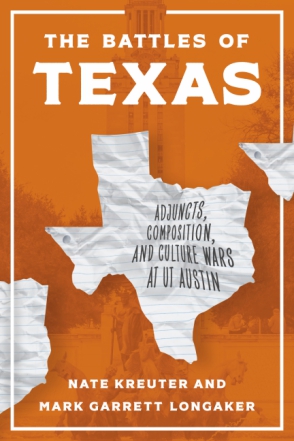
Nate Kreuter and Mark Longaker
The Battle for Texas: Adjuncts, Composition and Culture Wars at UT Austin
Penn State University Press, 2025
158 pages
$99.95
Reviewed by Cal Curran
The Battle for Texas: Adjuncts, Composition and Culture Wars at UT Austin chronicles the adversities faced by rhetoric and writing professors at The University of Texas at Austin in the 1980s. Nate Kreuter, a former student at UT, and Mark Longaker, a current professor, write with the concerns of a general audience in mind. The reader may be surprised to learn, for instance, that the Velvet Underground’s Sterling Morrison left the indie-rock movement to become a medievalist at UT. Morrison’s an attention-grabber, but the reference to his presence around Parlin hall sets up a more pivotal character: Professor Joseph Kruppa, who led a committee that abolished the universal first-year writing requirement.
I stress the term “character,” because that is how the ensemble of professor emeriti are treated. Kreuter and Longaker’s book is all about the importance of teaching people how to write, but it also exemplifies the art of writing. They package their analysis in a compelling story, and are intentional about engaging their reader with drama as they offer solutions for present-day issues in the academy. As a reader, I was relieved by their method of academic writing. They recognize that entertaining the reader is a means of persuasion. Their narrative is accompanied by a digital archive called RhetCompUTX that contains all of the primary and secondary sources referenced in the written work; it is a public exhibition of their research process. Prospective administrators can use the archive to assess for themselves the success and failures of past professors. In the book, however, the authors make their own case for who they believe made the best administrator. They favor amicable negotiators and willing compromisers. When historicizing their employer, they are as practical as the predecessors they champion.
The book describes the English department’s difficulty managing a required first-year writing class called E306. At the beginning of the 1970s, fifty percent of students qualified for exemption, and it was considered a remedial course. In four years, that number plummeted to a twenty-five percent exemption rate. Most professors were unwilling to lower the University’s standards in order to deflate enrollment numbers. However, those same professors were unwilling to help teach the exploding number of students. Tenured faculty were repulsed by the course’s drudgery; for the most part, the course was manned by a growing body of guest lecturers who made roughly seven dollars an hour and graded nearly a thousand papers in one semester. There were also disputes about the methodology of teaching a required course. Part of teaching students to write is preparing them to think—this pedagogical goal incites other debates about what students ought to be thinking. Some professors championed an education in rhetoric as a means to sustain democracy in its potential to develop an engaged citizenry. Others supposed that America’s future managerial class needed mere technical proficiency in grammar. Course designs had to accommodate room for students to debate civic issues, engage their own interests, and gain technical composition skills; most professors prioritized one over the other.
Managing E306 amidst post-Cold War socioeconomic realities spiraled into two major catastrophes: (1) 50 guest lecturers were fired overnight without forewarning, now remembered as the Saturday Night Massacre; (2) A syllabus drafted and proposed to address the concerns of minority students caused a culture war that placed multiple English Department colleagues at odds in the press. Both events received national attention. They were, however, an inevitable effect of two unavoidable economic and social outcomes that Kreuter and Longaker identify as “austerity” and “diversity.” The Saturday Night Massacre was a response to austerity, and the controversial syllabus was a necessary answer to the demands of an increasingly diverse classroom. In the later twentieth century, public research universities were both accessible to more students and had lost the government subsidies that built them. By opposing these forces, many faculty members had their careers displaced.
Leading up to the Saturday Night Massacre, more students and fewer funds ballooned the number of guest lecturers. These lecturers received mixed receptions from tenured professors who were hired in the expansionary era of higher education. Some petitioned for lecturers to have the same benefits as full professors, while others resented diluting the significance and promises of tenure. Fifty instructors were deemed unsupportable and fired, while many other lecturers were reduced to part-time, and the university admitted to the irony of having to cancel long-held curricular requirements due to understaffing. In an interview, the department chair told Kreuter and Longaker that it was “impossible” to teach everyone how to write.
In fall 1989, the chair of lower division writing, Linda Brodkey, made one last attempt to impose a uniform curriculum on E306. She was hired because of her attention to the marginalized communities to which many of the English Department’s students belonged. She proposed a syllabus that addressed race and sexism in American society and asked students to write about contemporary issues. When select faculty dissented and went public about a proposal that would insert a multicultural bias into a required course, the department was hit with a firestorm of controversy. One vocal professor was even quoted by Lynne Cheney in her diatribe against radicals in academia. Kreuer and Longaker make the puzzling statement that “We might not be fighting the same culture war on twenty-first-century campuses,” but I would argue that we are. In the six years since I started college, academia has been reconstituted twice: first to address racism and then to erase any mention of it.
At the end of the book, the rhetoric faculty do away with E306 and the first-year writing requirement, which stabilizes their curriculum. They also split into their own department within English, and gain their own majors and graduate students. The authors credit the department’s ultimate resolution to the prudent, amicable, and compromising archetype they call “phronetic characters.” Admittedly, the more entertaining characters are ones Kreuter and Longaker deem “tragic” and “romantic,” those whose idealism tends to tilt futilely with managerial windmills. In one quixotic instance, a UT professor chastises a conference of academics by comparing their role in labor exploitation to modern day slavery. He sheds national attention on the issue; yet despite his best intentions the employees he defended felt endangered by his “pie-in-the-sky” demands in light of the Saturday Night Massacre. When the department forgoes tradition and revamps their course offerings, it is thanks to professors who disavow the ideal in favor of the good.
There are times when Kreuter and Longaker’s faith in the story’s excitement demonstrates the rhetorical strategy of over-promising. This is especially true in the book’s early chapters, when the professors have just been introduced and are mostly bickering over who has to teach first-year composition. Once their personalities are developed, and they engage in shockingly-public disputes about the future of education, it is remarkably easy to feel caught-up in the drama. Not only that, but it’s easy to form your own convictions and wonder how you would behave in a similar scenario. That, in the end, is the persuasive potential of storytelling. Sometimes, it’s worth reading a book written by two rhetoric professors.