Brian Soucek
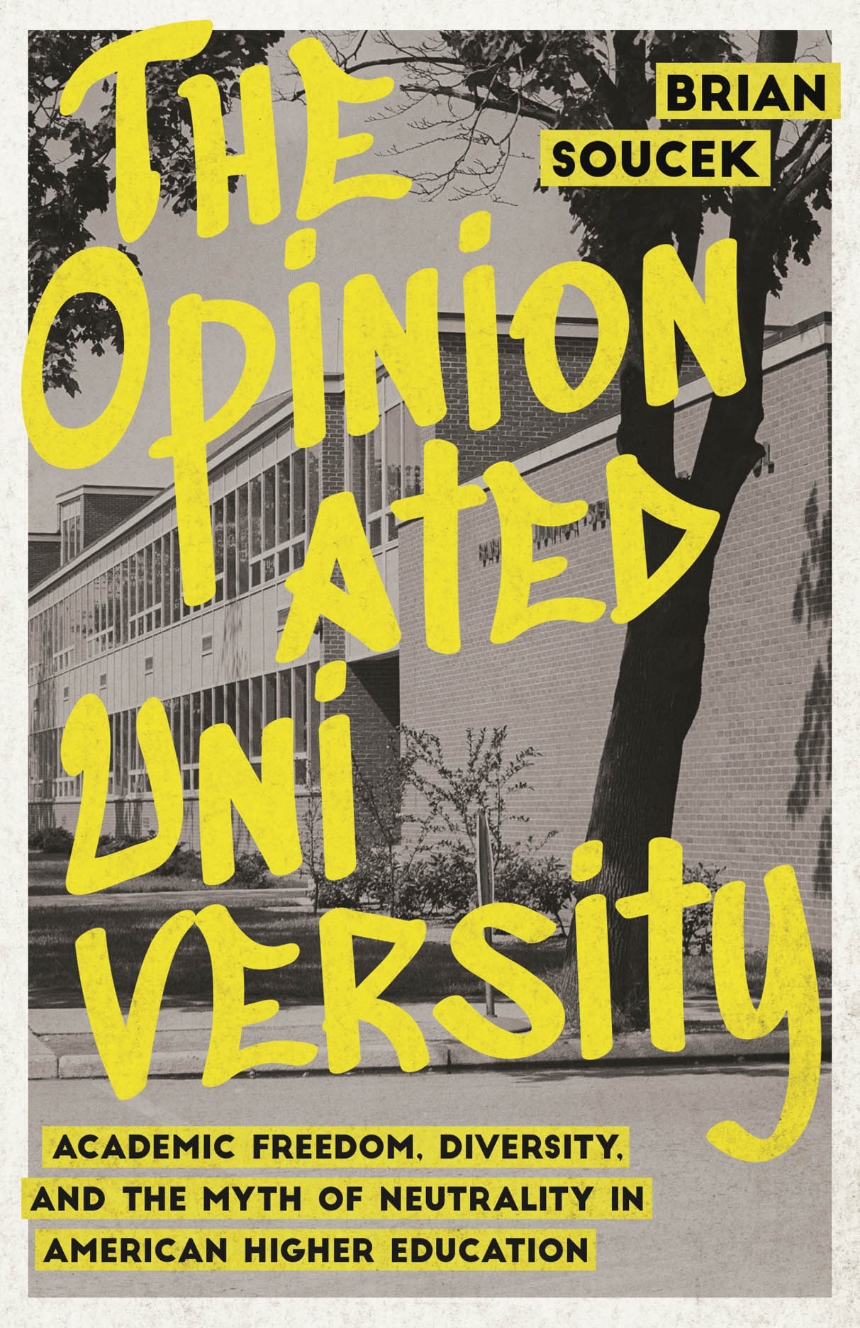
The Opinionated University: Academic Freedom, Diversity, and the Myth of Neutrality in American Higher Education
The University of Chicago Press, 2026
240 pages
$25.00
Reviewed by Michaela L. Pernetti
In December 2023, the presidents of Harvard, MIT, and Penn appeared before the House Committee on Education and the Workforce amid accusations that their campuses had failed to respond adequately to claims of rising antisemitism following Hamas’s October 7 attack and the heightened Israeli offensive in Gaza that followed. Their refusal to give a simple yes-or-no answer to whether calls for genocide violate campus speech codes (each correctly noting that the legal standard depends on context) ignited public outrage, resulting in two of their resignations. In the following weeks, some pundits blamed the supposed failures of diversity, equity, and inclusion (DEI) initiatives, which these critics said empowered “Marxist-centered groups” and subordinated academic rigor to ideological objectives. Others argued that universities should embrace institutional neutrality to avoid unnecessary political entanglement.
Brian Soucek’s The Opinionated University: Academic Freedom, Diversity, and the Myth of Neutrality in American Higher Education rejects neutrality as either feasible or desirable, clearly stating that “the promise of neutrality is just an illusion.” A law professor at the University of California, Davis, and an expert on academic freedom, Soucek argues that universities inevitably express values through their actions—whom they hire, how they allocate resources, and what they choose to invest in. Further, silence is not neutral; it is itself a form of expression.
Soucek begins with the controversy over mandatory DEI statements in faculty hiring and evaluation, which critics describe as “loyalty oaths” and “political litmus tests” that chill academic freedom and impose viewpoint conformity. This perception rests on a fundamental misunderstanding of academic freedom: it is not an unlimited personal right to say anything without consequence, rather, it is a professional expectation that scholarship and teaching meet disciplinary standards defined by expert scholars in their fields. While universities are not obligated to treat DEI as central to their mission, they are legally permitted to do so—and to evaluate faculty accordingly. In the second chapter, Soucek contrasts the inflated threat of DEI statements with student teaching evaluations and U.S. News and World Report rankings—two far more pervasive and empirically-documented threats to academic freedom. Both of these practices outsource judgments about academic merit to individuals or entities lacking disciplinary expertise, giving them disproportionate influence over institutional identity.
The third chapter critiques the Kalven Report, a 1967 University of Chicago document that argues universities should avoid taking political positions except when their core mission is threatened. Soucek contends that this exception renders neutrality impossible, as determining what counts as a threat to the mission is itself a value-laden judgment. Moreover, universities express values through actions (and inaction) as much (or more) as through statements. Rather than strict neutrality, Soucek advocates for “institutional restraint,” suggesting that the more central an issue is to a university’s or a department’s core mission, the more it should be willing to face the potential costs to stand up for its identity.
In the fourth chapter, Soucek deepens his argument through three case studies in which UC Davis used institutional speech to address harms it had caused or enabled. In the first two cases, the university’s adherence to federal mandates—in conflict with its own nondiscrimination policies— resulted in the marginalization of its own students, creating an obligation to acknowledge and address that harm. In the third case, the university chancellor—unable to legally block Charlie Kirk from speaking at a campus event—released a video criticizing Kirk’s divisive rhetoric and affirming solidarity with transgender students. As a result, Kirk ended up spending much of his talk denouncing the chancellor’s video rather than targeting students: the chancellor’s preemptive counterspeech both protected vulnerable students and reframed the debate. Through these cases, Soucek illustrates institutional counterspeech as a tool for acknowledging harm, supporting community members. and establishing norms that are conducive to the mission of developing and advancing knowledge.
The fifth chapter explores the complexity of regulating speech in different campus spaces. In public spaces, like a quad, the First Amendment governs, and universities generally aim to maximize expression consistent with safety and order. Classrooms, by contrast, are governed by academic freedom rather than pure free speech, as teaching requires professors to evaluate ideas based on scholarly merit and disciplinary expertise. Ultimately, the specific balance a university strikes between robust expression and other values such as equality and expertise is a fundamental expression of its distinctive mission.
The book culminates by posing the question: if universities are unavoidably opinionated, who should determine those opinions? Soucek’s answer is robust faculty governance. As disciplinary experts, faculty members are best positioned to articulate institutional values and resist political or donor interference. He acknowledges the challenges to effective shared governance but insists that academic freedom depends on it. Soucek rejects what he calls a “snowflake account of academic freedom”—the notion that faculty are too fragile to withstand disagreement with their institution’s positions, arguing instead that a strong culture of academic freedom produces faculty capable of dissenting from, or helping shape, institutional viewpoints. At a time when state politicians and external donors increasingly attempt to redefine university missions and suppress fields of inquiry, Soucek contends that neutrality is not only impossible but irresponsible. Universities must articulate and defend the values that enable knowledge creation.
The Opinionated University, therefore, provides a thorough and increasingly timely legal investigation of academic neutrality. It will be of great value to scholars in higher education or legal studies and those engaged in governance at institutions facing political pressure. Soucek presents complex ideas in a way that feels welcoming, making the book additionally suitable for readers interested in the topic, even if they have limited background knowledge. Throughout the book, Soucek uses case studies to show how these conflicts unfold in practice. He is careful not to adjudicate the underlying disputes themselves, focusing instead on university responses and the legal, political, financial, and social forces shaping them. While this restraint occasionally flattens complex issues into overly neat examples, this focus is necessary for presenting so many cases while keeping the analysis tightly centered on institutional dynamics, and this book remains a valuable resource for anyone concerned with academic freedom and institutional responses in an era of mounting political pressure.