Hamid Dabashi
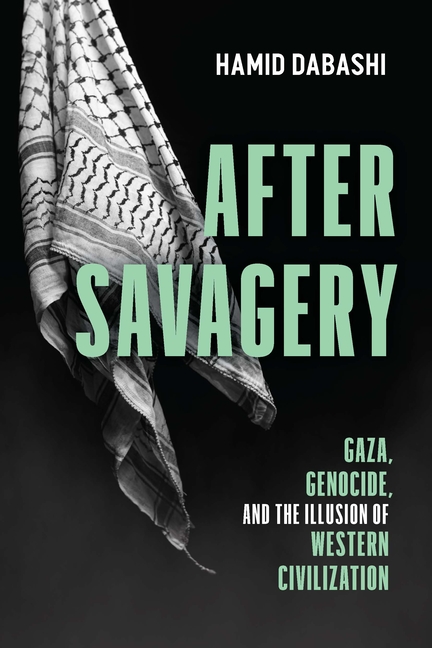
After Savagery: Gaza, Genocide, and the Illusion of Western Civilization
Haymarket Books, 2025
304 pages
$19.95
Reviewed by Colleen Small
Hamid Dabashi’s book opens with a preface called “‘Exterminate All the Brutes,’ Again!” “Again!” gestures toward the ways Dabashi reads recursivity of imperial violence: the violence of history is the same violence reborn in Gaza today. Dabashi has taught Iranian Studies and Comparative Literature since the eighties, and has written over two-dozen books, including Islamic Liberation Theology: Resisting the Empire (Routledge, 2008), Post-Orientalism: Knowledge and Power in Time of Terror (Transaction Publishers, 2009), Iran without Borders: Towards a Critique of the Postcolonial Nation (Verso, 2016), and The Future of Two Illusions: Islam after the West (University of California Press, 2022). His method of reading historical violence alongside present-day violence remains unfortunately apt: not six months after Dabashi’s latest book was published, Mohammad Mansour reported for Al Jazeera that Gaza-based Civil Defense teams “have documented 2,842 Palestinians who have ‘evaporated’ since the war began in October 2023, leaving behind no remains other than blood spray or small fragments of flesh.”
Israel uses internationally-prohibited thermal and thermobaric weapons that surpass killing and achieve near-total destruction. When these weapons ignite, temperatures exceed 6,330 degrees Fahrenheit (2026). The US generates this intense heat and destruction; the US produces bombs like the MK-84 that Israel unleashes on mostly civilian human bodies. And when an MK-84 explodes, “tissues vaporize and turn to ash. It is chemically inevitable” (2026). Boeing, based inVirgina, continues to spawn a precision bomb designed to destroy human lungs and soft tissues without harming a building’s structure: the pressure wave collapses lungs just before the heat turns soft tissues into ashes. The bomb’s design protects human handiwork and creative production, strategically discarding the inconvenience of lungs and tissues that course with life.
Over six months after Dabashi published After Savagery, the destruction he condemns, and has condemned for decades, continues—hurtling forward, alive, vivid, reaching horrifying new heights. In Habashi’s words: “This savage European colonialism does physically to the body of the colonized what ‘Western philosophy’ had already done to their soul—defined it as an ontological impossibility.” According to a book talk Dabashi gave in fall 2025, it was while mourning genocide that he found his central argument: not that “the West” supports Israel, a settler colony, but that “all of Western colonialism and imperialism in the last 500 years [comes] to a pinnacle in this history” (2025). After Savagery sidesteps distracting questions about whether the US abuses Israel or Israel manipulates the West. Dabashi writes instead from the premise that the US and Europe constitute Israel’s project. He asks: If Israel is the West and the West is Israel, what is Palestine? His answer demonstrates how Palestine became “the simulacrum of the world at large,” how “the world is represented by the extraordinary resilience of Palestinians for generations standing up to the theft of their homeland” (2025).
Dabashi develops his sweeping argument across six chapters. His first chapter locates Palestine’s significance. He describes Palestine as a simulacrum for the world by identifying its particular-yet-universal quality, “without disregarding its particularity to a fake universality.” In Chapter Two, Dabashi builds on this symbology by naming Israel a simulacrum for the West: a typifying regime, a “totemic mascot,” that captures “what the world has endured from Western colonialism and imperialism for centuries.” Israel finds theoretical lifeblood not among reactionaries, but Western critical theorists. Dabashi’s third chapter, “Poetry after Genocide,” moves from critical theorists—some of whom, like Theodor Adorno and Max Horkheimer, questioned poetry’s efficacy after the Holocaust—to poetics, and concludes that works like Pontecorvo’s Battle of Algiers remain vital. Poetry appears barbarous, he says, only when Euro-centric theorists attach it to a project that finds Auschwitz uniquely nefarious while never acknowledging international victims of European colonial savagery. While Chapter Four takes aim at Western philosophy, Chapter Five picks up Giorgio Agamben’s work on the camp and the state of exception. Dabashi argues that the state of exception (Palestine, “a state of exception made unexceptional”) exists on the site of the camp, and it is in fact “the state of modernity as Europe has crafted and violently universalized it.” In Chapter Six, “Palestine beyond Borders,” Dabashi expands upon what it means for Palestine to symbolize the world by wedding the Palestinian struggle to global fights for justice.
Throughout the text, Dabashi focuses on how Western philosophy and imaginaries formed in a kiln of racism—not incidental racism, but foundational racism. He reads Adorno and Horkheimer, Rudyard Kipling, Agamben, Hegel, Levinas, Locke, Hume, Kant, Hegel, and more in light of Palestine. Unflinchingly, he indicts his own training. The West is “the existing political order,” Palestine the ravaged earth; the West a false premise, Palestine where the West’s spurious moral authority is buried; the West’s an apartheid imagination, rendering Palestine “the wretched of this earth.” Dabashi recognizes that Palestine forms the space to imagine “the moral and normative agents of a whole different historiography.” He also insists that the Jewish Holocaust and Palestinian genocide are inextricably connected:
The memory of the Holocaust must be liberated from Zionist abuse and wedded to the memories of all other genocidal terror on this earth, particularly to the Palestinian genocide. The specificity of these genocides must be marked but not trivialized. They must be uplifted from a politics of identity and transcended to become the moral cornerstone of a metaphysics of alterity. Palestinians must mark their genocide in Jewish terms, and the Holocaust remembered in decidedly Palestinian terms—both in the active remembering of the Indigenous, African, Latin American, and Asian sufferings endured for millennia.
Dabashi crosses geographical and temporal boundaries to refuse the false hegemony of Euro-Western philosophy and literature. And when he transacts in massive symbols while critiquing universalism, he does raise questions about how to characterize Western philosophy without reinforcing another sense of universality. Is there a singular Colonial Man, for instance? When colonizers steal from marginalized communities during colonial encounters, how should we account for practices that continue on, that become complicated in new ways after both theft and survival?
Still, Dabashi’s choice to name Euro-Western philosophy as such, instead of assuming its universality, is compelling, and particularly relevant on college campuses today. E3W is “an interdisciplinary consortium of graduate student and faculty scholars across the fields of critical race and ethnic studies; women’s, gender, and sexuality studies; Native and Indigenous studies; and Black and African diaspora studies, among others.” On February 12, the president of The University of Texas at Austin announced that the Department of Women’s, Gender, and Sexuality Studies; the Department of African and African Diaspora Studies; the Department of American Studies; and the Department of Mexican American and Latina/Latino Studies will close by the end of 2027. A single Department of Social and Cultural Analysis will absorb their communities, their funds, and their autonomy. And while what happens at one university is not central to fights for liberation, it’s not separate from those fights, either. Dabashi’s work aims directly for the structures that make “ethnic” literature marked literature—that make the default literature, the default philosophy, and the default civilization all assume European origins, and occlude its savagery.
The “dysfunctional empire” and our university earned this critique, and Dabashi my respect. E3W is one among many fraught spaces to heed his call to historicize European philosophy. Because even through unrelenting destruction, people remain to create physical and textual archives. That archive can’t restore worlds lost forever, but it does prove one of Dabashi’s points: “The single most important site of Palestinian resistance are Palestinians themselves. And the Palestinians themselves are all over the place” (2025). They can’t be snuffed out. May Palestinians find safety all over the place, and Europe’s violence and deadbeat philosophies find their proper (resting) place.