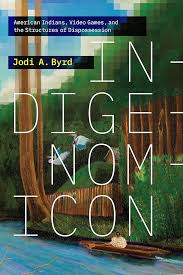
Jodi A. Byrd
Indigenomicon: American Indians, Video Games, and the Structures of Dispossession
Duke University Press, 2025
320 pages
$28.95
Reviewed by I. B. Hopkins
Jodi Byrd’s recent book resists the “Columbusing” discourse of academia that would describe all important contributions as claims on new intellectual territory. Indigenomicon represents, rather, a deepening of conversations which already cross decolonial theory, game studies, and cultural studies. According to Byrd (who is “a queer nonbinary Chickasaw player of games”), “Students come to my courses on video games already ready to tell me that games are colonialist and racist, misogynistic and transphobic. Still, those same students play the games they critique, and more, they love them. As do I.” Inasmuch, critique and love twine throughout Byrd’s contribution to Duke University Press’s “Power Play” series on “Games, Politics, and Culture.” For those “already ready” to engage in a sustained examination of the ways in which settler-colonialism conditions the imagined spaces of video games, this book offers a serious and theoretically-rigorous grounding from which to better observe the familiar landscape of our highly-mediated, inextricably colonial lives.
Indigenomicon, in Byrd’s own words, “is composed as a compendium of relational essays that sit with, rather than build a definitive argument about, the ludonarrative dissonances of video games to consider how games serve settler colonialism as ongoing recursive and discursive structures of territorial dispossession and acquisition counterposed to Indigenous modes of governance, livability, and relationality.” “Ludonarrative dissonance,” a term of art in game studies, refers to the perceived mismatch between gameplay and storytelling that often occurs in video games that aspire to narrative sophistication while contending with players’ expectations. For some, this inherent tension disqualifies playable games from achieving the status of genuine art, and—rather than weighing in—Byrd lingers with the concept as a corollary to Patrick Wolfe’s well-known thesis that “Invasion is a structure not an event.” In other words, regardless of a game’s events, concepts of space, relationality, and conquest that underwrite video games reproduce the logics of settler colonialism. Undeterred by this paradigm, Byrd employs a methodology of disambiguation across several genre-agnostic case studies, reading a range of commercial and art games alongside novels, poetry, film and tv, historical documents, and treaty law. The result is a perspicacious account of Indigeneity and settler colonialism as transhistorical realities invested with new meaning through feminist and queer-of-color critique, a forceful analysis that “grinds on these registers of relationality.” These terms (“grinding/ground” and “relationality”) enrich Byrd’s theoretical engagement with the teachings of Édouard Glissant, Shona N. Jackson, and wider networks of Black critical thought. They find hope in the recursivity of gameplay and its capacity to make structures visible and, ultimately, to imagine alternative possibilities.
Chapter One fleshes out Indigenomicon’s relation to H. P. Lovecraft’s Necronomicon, a fictional “book of the dead” that appears repeatedly throughout his influential and xenophobic body of works. The book also, crucially, has had a long cultural “half-life” well beyond the author’s death. This cultural endurance offers a powerful metaphor for Indigeneity as a pervasive zombie force in American culture; an undead, uncivil, and unhoused threat to the orderliness of settler domesticity. Analyses of Mark Z. Danielewski’s novel House of Leaves (2000) and two video games, What Remains of Edith Finch (2017) and Until Dawn (2015), in this chapter demonstrate the “white settler fragility” coded in each rehearsal of the trope. The second chapter looks back to the early legal and pedagogical grounding for US-Native relations and suggests that American Indian nations today operate through modes of productive refusal to read signs of domination (“colonial unknowing”), using the examples of Doctor Who (1963-present) and Red Dead Redemption 2 (2018) along with Ursula Le Guin’s Always Coming Home (1985). Chapter Three takes up scenes of apocalypse—“the shitty future,” according to Māori game designer Naphtali Faulkner—and the depiction of Indigenous death and violence folded into games with major studio releases like BioShock Infinite (2013). The chapter leverages queer and object-oriented ontologies to ask what video games essentially are and do as social phenomena, and whether they might be deployed for colonial resistance.
While broadly lauded for its attention to historical detail, the Assassin’s Creed franchise also plays out, according to Byrd, a fantasy of representation as reparation. Chapter Four interprets the game’s global-to-local scales to disturb presumptions about furtive associations with an inevitable march of empire. At the same time, Byrd articulates their own relation to Chickasaw homelands as they are depicted in the installment of the series set in eighteenth-century New Orleans. The wide-ranging Chapter Five advances Byrd’s thinking through “late colonialism,” a term coined late in the book to describe settler colonialism as naturalized-yet-unsustainable within neoliberal, technocratic society. Byrd places the dark fantasy roleplaying game Dark Souls (2011) alongside other games, a novel, poetry, and historical documents to reveal gameplay’s “technological structures of dispossession,” which leaves subjects both landless and selfless. Here, Indigenomicon’s “grinding” approach takes its most ambitious turn, and Byrd ultimately argues that entertainment technology must be reintegrated into a relationality with place and peoples. The slippery binaries between gameplay and narrative, between Black and Indigenous representation in media, between place and belonging, past and present all meet in the book’s conclusive reading of HBO’s Westworld (2016-2022). The show’s “open world” and retribution narrative provide a succinct encapsulation of the recursive interrogation at the heart of Indigenomicon, the gameplay of which is built around a structure of encounter rather than any particular event.
Walking as it does along the indeterminate rift between expressive culture and commercial technology, Indigenomicon’s broadest contribution is its link to disciplinary debates about higher education. Byrd suggests in the Introduction that the “so-called crisis in the humanities” manifests anxieties about zombified (dead but not) critique from Indigenous and other marginalized perspectives. Byrd troubles the supposed institutional neutrality of science and relates that misapprehension to the backward logic of a public discourse in which “critical race theory is deemed racist.” This book is an artifact of Byrd’s thinking over the past decade and a half, the time elapsed since their indispensable first monograph, The Transit of Empire (2011), and it reflects today’s radically different state of education and public discourse. Indigenous Studies’ gains within the academy were always contingent, as it turns out, and so Byrd’s turn to broader landscapes of representation and relation through the medium of video games (which are still suspect in some quarters of scholarship) models the intellectual nimbleness required to operate under conditions of perpetual crisis. Scholars with an interest in game studies are likely to find the perspectives of Indigenomicon the most comprehensive Native critique of video games available to date. Much more broadly, though, Byrd’s exceptional book provides useful readings of fantasy, horror, and science-fiction across multiple genres; prototypes for engaging intersections of Black, Indigenous, and queer critical traditions; and a grimoire full of spells to illuminate the embodied dissonance of settler colonialism.