Kwame Anthony Appiah
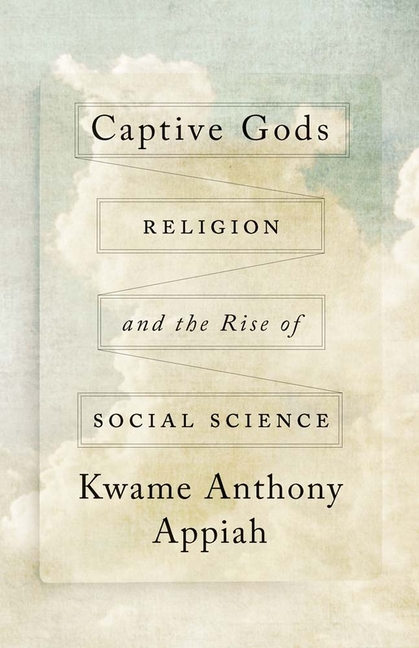
Captive Gods: Religion and the Rise of Social Science
Yale University Press, 2025
344 pages
$32.50
Reviewed by Alexander Cathis
Kwame Anthony Appiah begins Captive Gods by proposing that, in secular theories of religion, gods are “secret captives” of the societies that worship them. He subsequently turns the metaphor back on the discipline, suggesting that the early theorists who pioneered social and religious studies were likewise “secret captives” of their own time and place: the late nineteenth and early twentieth centuries in Western Europe. Appiah aims not to solve some problem of religion or society but rather to “excavate a fraught and consequential stratum of intellectual history.” This excavation considers four main theorists—Edward Burnett Tylor, Emile Durkheim, Georg Simmel, and Max Weber—regarded among the architects of the discipline of sociology. Captive Gods provides an entertaining primer on social theory’s history and research methods. By engaging with the aforementioned theorists’s histories, philosophies, and intellectual impacts, Appiah demonstrates that the studies of society and religion not only developed alongside each other but were also inextricably linked, complete with shared intellectual tools, frameworks, and reciprocating influences. He argues that these correspondences are not just the past and present of society and religion, but also their future: society and religion have and will continue to grow together.
Appiah begins with a defense of his methodology; specifically, his selection of four Western European theorists born within six years of one another. He acknowledges that it may seem counterintuitive to theorize an intellectual movement through an extremely narrow historical window, and he concedes the major influence of theorists both inside (Marianne Schnitger) and outside (Harriet Martineau, W.E.B. Du Bois) the historical context of his study. He admits that his “argument could surely have unfolded though other thinkers” and that “disciplinary canons are always in the process of being reshaped.” However, he justifies his selection through two key criteria: representativeness and influence. Their work, he argues, establishes an expansive intellectual landscape upon which successors built still-standing academic structures. In a thematically apt final defense, Appiah emphasizes reciprocity, warning against biografismus—the biographical fallacy of reducing an idea to its author—and against the opposite error of denying any connection between a thinker’s life and their thought.
Appiah devotes most of the book to reviewing and discussing these thinkers. However, these chapters function primarily as exposition; the book’s most original insights emerge in the framing sections that precede and follow the intellectual history. This emphasis does not diminish the value of Appiah’s excavation: it is engaging and informative, particularly for readers without formal exposure to sociology. To supply necessary background and to encourage a balanced stance between the two fallacies identified above, Appiah reconstructs the historical, social, economic, and personal contexts in which his subjects worked.
Captive Gods’s major insightsare in its final chapter and epilogue, where Appiah fills out the disciplinary origin stories with analysis. Appiah describes his study as a reconstruction of “origin stories,” as these have lasting significance. He demonstrates that significance by bringing contemporary arguments—refutations and endorsements—into dialogue with these founding positions. He contends that, even as sociology has moved toward other disciplines and methods (for example, quantitative modeling, evolutionary biology, and history), there has been a persistent engagement with the origin stories he names. One example draws on interpretive sociology to revisit the question of whether society depends on religion. Another examines claims, prompted by efforts to make religion scientifically intelligible, that religion is a necessary precondition of society. Appiah captures this recurring struggle succinctly: “The old gods of social science rise from their graves, strive to gain power over our thought, and resume their battle among themselves.”
The epilogue weaves Appiah’s intellectual formation in the social sciences with reflections on contemporary scholarship’s ongoing conversation with the classics. He returns to a foundational question: what is ‘religion?’ Surveying historical definitions and major definitional strategies (essentialist, eliminativist, family-resemblance), he argues that a definition’s usefulness is purpose-relative—legal, political, historical, psychological, and so on. Accordingly, he does not propose a single definition, since that is not the book’s aim. Instead, the epilogue’s value lies in explaining why the concept remains elusive and how that elusiveness helped shape the intertwined development of sociology and the study of religion. Appiah suggests that these fields have grown more tightly linked over time and that future debates will continue to revisit—and rework—classic arguments.
Captive Gods is an engaging and informative study with clear appeal to a broad audience. The book fulfills Appiah’s stated aim: an origin-centered intellectual history that connects the rise of social science to the secular study of religion while insisting that these beginnings continue to matter for contemporary social thought. Appiah pairs historical and philosophical analysis with vivid stories, making the book accessible to interested non-specialists and early-career scholars while still offering enough rigor to reward specialists. A straightforward structure helps readers focus on the substance rather than navigating the format, and the prose remains academic but readable throughout.
However, while the extended historical reconstruction is valuable, the book might have devoted more space to Appiah’s own synthesis and takeaways. Even if his background-first approach fulfills Appiah’s self-defined goal of excavating intellectual history, the exposition could be tightened while preserving its most valuable yields—his insights into the relationship between society and religion. Relatedly, the interdisciplinary range that allows Appiah to situate his thinkers also blurs the book’s genre and, with it, the criteria by which a reader should judge its success: should it be read primarily as intellectual history, as theoretical intervention, or as an extended literature review? To be fair, however, that hybridity may be deliberate, recasting the reciprocity between sociology and the study of religion at the level of method, where past debates are used to illuminate present ones. And despite these minor shortcomings, Captive Gods nonetheless offers a strong historical and theoretical foundation for sociology, alongside a persuasive account of how and why sociology and the study of religion remain tightly intertwined.