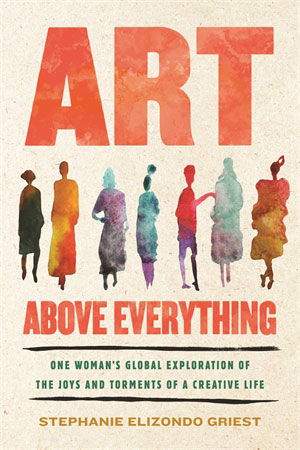
Stephanie Elizondo Griest
Art Above Everything: One Woman’s Global Exploration or the Joys and Torments of a Creative Life
Penguin, 2025
252 pages
$30.00
Reviewed by Samuel Marentes
A few years before novelist Jenny Offill formally introduced the term “art monster” in her work Dept. of Speculation (2014), journalist and travel writer Stephanie Elizondo Griest was doubting her decision to choose her craft over her relationship, over her opportunity to have children, and even over a stable income—something she hadn’t yet experienced in her then-twelve years as a writer. In Griest’s deliberations, she came to terms with her history of prioritizing her art over all else. Eventually, she began to look for others of her ilk, coining the term “art monks” to describe those unconcerned with the mundanity of life, who forgo marriage or children, or who commit themselves wholly to their art. Griest’s book Art Above Everything: One Woman’s Global Exploration or the Joys and Torments of a Creative Life captures her decade-long exploration of these art monks. She features a slew of interviews with female artists who have dedicated themselves to their craft with the intent to answer one central question: is art worth it?
Griest and her subjects produce an unrelenting but realistic yes. Griest dedicates her thirteen chapters to artists in cities across the globe. She asks these artists about their decision to lead lives dedicated to art, and their experience living without some of society’s traditional markers of success. The interviews are loose in structure, as Griest offers direct accounts of her time with the artists instead of transcribing a Q&A. These accounts are balanced with Griest’s personal reflections on the subjects at hand, sprinkling in her commentary on the politics or culture of the time. Each chapter offers its own justification for why art is enough, and why it deserves to be prioritized above all else, detailing what a career focused on craft has offered each featured artist. In closing, Griest poses more specific questions and answers about the role of art in an artist’s life, rounding out the real-world examples in the chapters. Griest’s book works as both a memoir of her travels and a collection of artists’ lives, a reliable source of inspiration for any artist seeking proof of their craft’s value.
The premise of Art Above Everything is interesting enough on its own to be a rewarding read, but it has plenty to offer on the level of style, delivery, and construction, thanks to Griest’s careful management of her register. Grise’s background in journalism comes through clearly: her tone often shifts into an objective, precise mode, and her sentences are simultaneously tight and never lackluster. Especially when Griest writes about the artists’ works, the book reads like a montage of reports by a trained reviewer. Praise is sparse, as she feels no need to embellish or qualify the art in focus; her literal reporting of the piece speaks for itself, the beauty evident in the reader’s mental image of Griest’s words.
Balancing her journalistic tendencies, the work is also deeply personal—it’s not uncommon for Griest’s personal anecdotes to garner more interest than the interviews themselves. Art Above Everything explores its author just as much as it explores her subjects, and the autobiographical sections are filled with joy, heartbreak, and intrigue, allowing those chapters to function as intimate, insightful breaks from the international nature of the rest of the book. Regardless of which artist is in focus—Griest or her interviewees—the book explores how these artists live and what art means to them. Griest’s writing style, perhaps the most immediately attractive aspect of the book, is the perfect guide.
While it might be difficult to imagine a pessimistic response to Griest’s question, her written deliberation of it suggests that something is missing. The first sentence of the book’s de facto introduction explicitly asks: “Is art enough?” The chapter posits indecision, but the undercurrent is always in the affirmative, never seriously considering how art might not be worth it—the book assumes its reader will answer in the negative. The book opens in a defensive position, and possible counterarguments don’t appear until later in the work. Chapters Four and Ten—phenomenally written, standout chapters—offer compelling complications in Griest’s argument. The reader realizes the contradiction between art’s capacity for moral good and its unfortunate, permanent tie to an income, revealing two things which are often prioritized above art itself: ethics and money.
Chapter Four features a few artists from Romania, but most pressingly is a section on Anca Petrescu, the 24-year-old woman appointed to design Romania’s House of the People. Designing a monumental building for an authoritarian regime brought upon not just criticism but death threats for Petrescu; still, the architect dedicated much of her life to completing her work. While drawing direct comparisons to Faust, Griest wonders if “[Petrescu’s] personal ambition [was] so profound, it overrode her humanity”—the kind of artist who muddies a sense of moral good for their work is a contentious issue for the author. Regardless of whether one agrees or disagrees with Griest’s assertion, a hole opens in her own claim that art can be prioritized over everything; Griest wonders whether there’s reason to put art second to our moral compass.
Another potential argument arises in Chapter Ten, a beautiful demonstration of Art Above Everything‘s balance between personal and journalistic registers. Griest’s subject is Chicana writer and her comadre, Sandra Cisneros, and she centers their honest conversation on what is inarguably most artists’ biggest obstacle: money. The chapter’s prose allows the reader to breathe in the comfort of their friendship, but it also includes the somber reminder that, facing extreme poverty, Cisneros experienced a shuddering, threatening bout of depression. The reminder harkens back to Griest’s early career, always on the verge of quitting her life as a writer until the next grant, the next residency, the next publication. One can’t help but wonder about all the artists lost to poverty, and Griest’s final remark about how her “relationship with writing tarnished the moment [she] monetized it” plants the seeds of doubt for anyone who desperately wants to share the book’s affirmative stance.
Thankfully, Griest is clearly aware about the contentions built into her argument. The final section, something of a postscript for the book, is called “The Answer(s),” where Griest sets definitive responses to the questions she explores throughout Art Above Everything. She acknowledges potentially forgoing a steady income; however, Griest argues that artists shouldn’t practice their craft for the sole sake of a paycheck. While not discrediting a better system of support for artists, Griest emphasizes that art’s value isn’t quite definable. Defining art’s value isn’t the point, and Art Above Everything maintains the maybe-naïve but inspiring position that creation is its own reward. Despite reasonable skepticism, our faith in it must stand firm.