Leon J. Hilton
Counter-cartographies: Neurodivergence and the Errancies of Performance
University of Minnesota Press, 2025
232 pages
$27.00
Reviewed by Jeremy Boorum
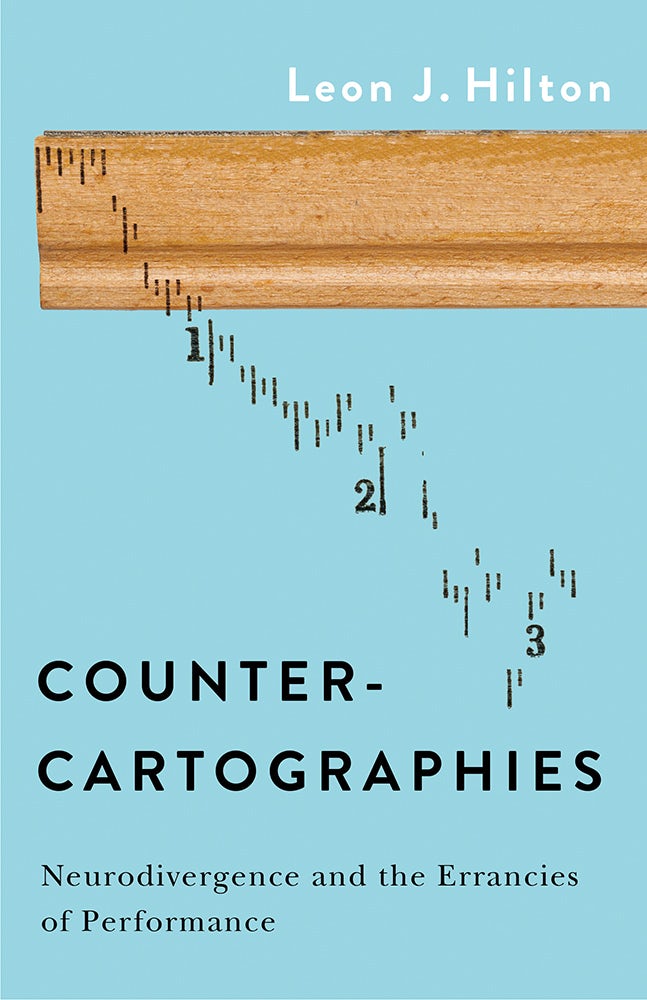
When we turn our gaze from the cartographies of normalization, how will we chart the histories and futures of neurodivergence? In his recent work Counter-cartographies: Neurodivergence and the Errancies of Performance, Leon J. Hilton remaps neurological difference beyond diagnostic taxonomies, instead reading neurodiversity across a series of performances, aesthetic projects, political and social movements, and intellectual dialogues. Drawing from Fernand Deligny’s ‘lignes d’erre’ (wander lines)—a concept of social relationality that arose from Deligny’s attempts to create a nonsymbolic system for representing-without-interpreting people’s quotidian trajectories—Hilton attributes an errant quality to neurodivergence, a term he argues “suggests a spatial metaphoric of the aslant and askew.” By thinking about neurodiversity along the lines of movement, direction, and spatiality, Hilton asks readers to reimagine neurodivergent forms and expressive modes as acts of resistance. Hilton describes these aesthetic and cultural productions as ‘counter-cartographic performances,’ forms that seek to “dishabituate the neurotypical sensorium by deactivating the rules and logics that normally govern the terrain of the earth and the territories of the self.” In the opening pages of the book, Hilton powerfully introduces this concept through an analysis of Javier Téllez’s One Flew Over the Void (Bala perdida [Stray bullet]), a performance featured at Tijuana’s 2005 inSITE public arts festival that ended with an American daredevil performer being launched by cannon across the US-Mexico border wall. Bala perdida’s concluding act, composed in collaboration with patients from a psychiatric hospital in Mexicali, not only critiques the geopolitical hyperpolicing of the US-Mexico border, but simultaneously illuminates the spatialized binary between the normal and pathological, a tension which animates Hilton’s argument throughout the book.
In Chapter One, Hilton examines the figure of the wild child that is mapped onto the bodies of autistic and neurodivergent children. He begins this chapter with an analysis of the sensationalized case of Victor of Aveyron, a non-speaking child who wandered through the French woodlands in 1798 and became a spectral figure in early medical literature on autism. Through close readings of Victor drawn from the diaries of his physician Jean Marc Gaspard Itard and his depiction in François Truffaut’s 1970 film L’enfant sauvage (The Wild Child), Hilton illuminates how European colonial fears and anxieties about wildness mirror emergent civilization and medical discourses in the nineteenth-century and beyond. Later in this chapter, Hilton juxtaposes the depictions of Victor with Fernand Deligny’s 1971 documentary Le moindre geste (The Slightest Gesture). Deligny’s work, which haunts the majority of the book’s chapters, departs from the behaviorist ideas of Itard and instead embodies what Hilton describes as a ‘feral performative.’ By turning towards aesthetic forms that reimagine the wild and feral as “accumulation[s] of doings, redoings, and undoings,” Hilton demonstrates how these practitioners simultaneously disavow and resist early pathologies of neurodiversity.
This thread continues in Chapter Two as Hilton shifts his attention toward the carceral legacies and figurative imaginings of the asylum. Throughout this chapter, Hilton grapples with the fraught depiction of the asylum as both a site of confinement and a place of refuge for patients. Hilton analyzes Deligny’s notion of ‘asyluming,’ described as “a practice that creates a space for a different mode of relation and existence, one that does not take for granted the subject as the only endpoint but instead becomes the occasion for making a refuge for what is ordinarily called ‘insignificant.’” By drawing our attention from the institution, Deligny’s asyluming practice allows for an analysis of the kinship networks forming within these carceral regimes. Deligny’s models are especially apparent in his analysis of Frederick Wiseman’s 1967 documentary Titicut Follies. This censored film, which depicts life at Bridgewater State Hospital in Massachusetts, draws its name from an annual Christmas pageant performed by patients. As Hilton demonstrates, the film juxtaposes this utopian performance with violent scenes of force feedings and strip searches to illuminate the fraught relationships patients held within the walls of state psychiatric institutions. Hilton analyzes Wiseman’s documentary alongside Living Theatre’s play Paradise Now, Louis Althusser’s ‘ideological interpellation’ dramaturgical model, and Deligny’s practice of tracing ‘wander lines’ in order to explore the complexities of unmaking-and-doing asylum within carceral spaces.
Following this trajectory, Chapter Three considers cartography and mapmaking as interventions against the surveillance of neurodivergent individuals. Early in the chapter, Hilton reminds readers of the role of cartography in delineating the power of nation-states and argues that these same tools are employed as counterstrategies to combat the policing of neurodivergence. Drawing from Simone Browne’s scholarship on ‘racializing surveillance’ and André Lepecki’s theory of ‘choreopolicing,’ Hilton probes the ways in which errancy, wandering, and other embodied forms of neurodivergent movement resist state and legal systems. The chapter begins with an analysis of William Pope.L’s Crawls, a series of street performances and drawings which serve as alternative forms of knowledge production countering the gridded power structures of state cartographies. These illustrations serve as a precursor to Hilton’s central focus in this chapter, a close reading of the case of Avonte Oquendo, a fourteen year-old African American autistic student found deceased after wandering from their Queens middle school in 2013. This tragedy resulted in the New York legislature passing Avonte’s Law, a 2014 bill that allocated funds for electronic devices to monitor autistic children in public schools. This example demonstrates the racialization of disability within surveillance systems and illuminates the state’s desires to render deviant the errancies and wanderings attributed to autism and other forms of neurodivergence.
Chapter Four turns to sound and haptics to think about the autistic voice. This chapter examines a range of art installations, including Jonathan Berger’s An Introduction to Nameless Love and Mel Baggs’s In My Language, to examine the relationship between voice and embodied gesture. The chapter also considers representations of autistic and neurodivergent communication and voice within neurotypical environments, like street grids and city scenes. Similarly, the emphasis on voice and haptics shapes the book’s coda, where Hilton thinks about shyness as a counterstrategy to the taxonomic classification systems regulating neurodivergence. Much of Hilton’s coda focuses on the Shy Underground, a global vanguard movement, and analyzes Hamja Ahsan’s manifesto Shy Radicals. This work speaks out for the “militant introvert in the face of an extrovert-supremacist world” and reframes diagnostic language as a critical tool for shy and introverted persons to exert their political agency. The coda considers how we read shyness, and by extension neurodivergence, as performances of deviancy, but also as narratives of empowerment. In any case, the coda imagines a world that embraces and depathologizes shyness and introversion.
As much an unearthing, Hilton’s Counter-Cartographies exists as a form of worldmaking, a dream for a world which embraces autism and other forms of neurodiversity. Across the chapters in this book, Hilton beautifully draws maps that allow readers to see the contours and lifeworlds of neurodivergence, past and present. This book is a critical contribution to a growing body of scholarship on neurodivergence. Counter-cartographies will be especially useful for researchers working within theatre and performance studies, disability and mad studies, cultural studies, science and technology studies, and feminist and queer studies. Hilton’s text will undoubtedly inspire future generations of scholars analyzing neurodiversity to chart new pathways.