Carmen Winant
How We Practice
Dancing Foxes Press, 2026
104 pages
$24.95
Reviewed by Lucy Sternbach
“What is the difference between going to practice and having one? Can there be practice without bodies? Can practice be resolved, and if so, does it cease to be practice? Do some artists have a practice and others not? What are the implicit hierarchies of practice? Does practice ever end?”
Carmen Winant’s genre-defying book How We Practice opens with these questions which interrogate the meaning of “practice” on existential, political, and aesthetic levels. What do we mean when we use the word “practice” in the art world? The book makes a case for “practice’s” potential by attaining a dynamic, deep understanding of what the term might offer artists, all while admitting the challenge of dictating a single definition. Carmen Winant, an artist and the Roy Lichtenstein Chair of Studio Art at the Ohio State University, is best known for her work on archival and authored photographs, through which she examines feminist care networks and the sites of labor associated with abortion practices. For Winant, a practicing artist, writer, and teacher, the polysemy of the nearly ubiquitous term “practice” is an opportunity to explore the slippages of power relations between those various meanings. If the essays and collaged material in the book cannot answer the list of questions Winant asks at the beginning of her book in a definitive way, they at least give examples as to how we might respond.
The work is divided into sections that each examine the ways in which “practice” taps into the wellsprings of human striving, masculinity, power, jealousy, and interior struggle. Some sections are essayistic, while others are devoted to Winant’s collages, so portions of the book read like an art book as opposed to a theoretical text. As an artist and a former athlete, Winant questions the condition of “having a practice” as a means of inflecting oneself within larger oppressive power relations: at fifteen, she journaled about failing to reach her “potential.” “Twenty-five years later, I am in a different body, with different desires. I’ve come to understand that potential is a strategy (not an objective) and that failure is its most essential, mysterious part.” In order to interrogate the multivalent meanings of practice, Winant is intimate in her methods, taking the reader into her diary entries, to her childhood home, to her own shifting self-perception.
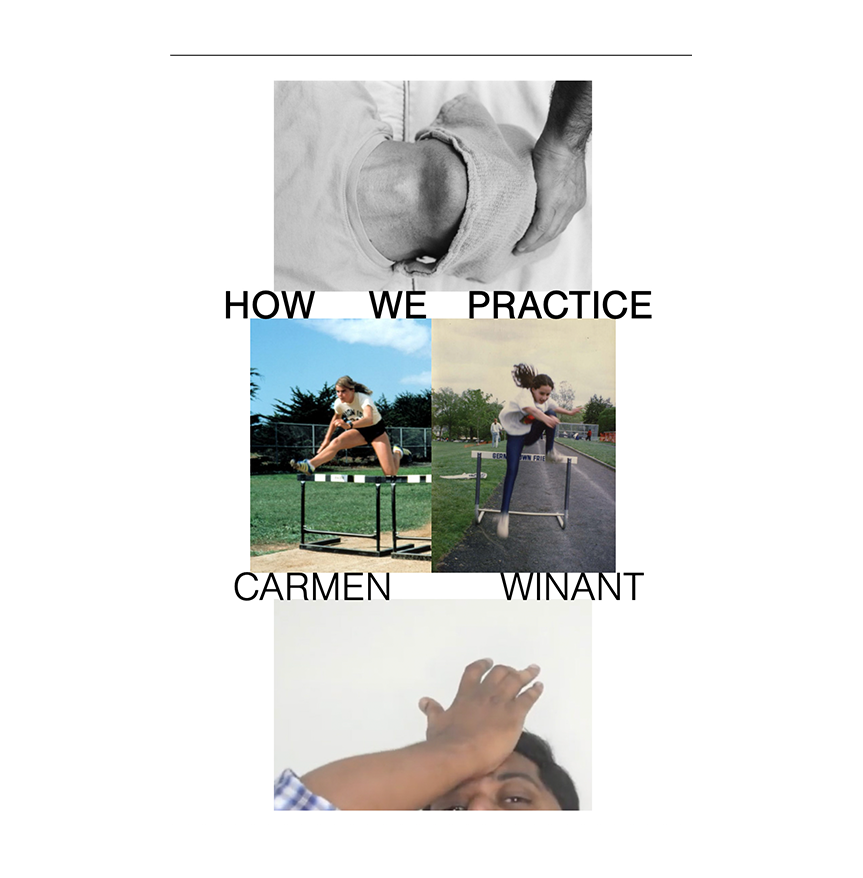
In the art sections, Winant delivers her own aesthetic qualities—quotidian, personal, unassuming. Winant includes pictures of herself from age thirteen to her time on UCLA’s track team. In one blurred image, she jumps a hurdle; in others, she turns on the track in bright sunlight, or runs through fields in black-and-white—her body posed, contorted. Winant places these personal collages in conversation with those of other artists and athletes: images of a ‘perfect’ gold-medalist female runner at University of Washington, Susy Favor, are scrambled with screenshots of YouTube videos from “the glute guy,” captioned “The Neck Weighted Plank.” Taken together, these photos help Winant demonstrate her argument that practice has an aesthetic value. These collages, at once scattered and methodical, show us Winant’s life and mind, as we track her thinking through photocopied images and book pages, personal archives, screen grabs, and subtitles. Each image is placed on the page without a frame; one image seems an extension of the other. These collages are self-conscious and unguarded in equal measure, and suggest a space of experimentation where ideas of practice can be examined.
In other sections, the intimacy that characterizes Winant’s work is less obvious, though no less tangibly felt. There are no scenes of overly tender embraces, or images of the body made to communicate some form of interiority. Instead, there are quiet, observational pictures that are elegiac or quotidian, captioned things like warming up and in practice. Pictures from the author’s own life, such as the one where she is embraced by a teammate or lover, softly press the line between representation and abstraction. These pictures insist on drawing from a personal world to draw the world together. The only image of Winant’s own artwork, “partner exercise for cervical isometric training (undated),” evokes a sensibility close to that of film noir, awash as it is in longing and melancholy.
In the section titled “Dismissal of Practice,” Winant reads the viral 2002 press conference of Allen Iverson, in which Iverson responds to a reporter who “chastises” him for missing practice. Here, Winant’s wide framework for practice falls short. “Rewatching this press conference cracked something open in me […] I study the young and handsome Iverson—a player plagued by a racist basketball league that repeatedly penalizes his Blackness, fining him now for how he wore his hair and clothing and accusing him of being drunk when he railed against them—considering what he reveals about the true nature of practice.” In the act of recounting Iverson, she re-files a racialized schema of his blackness. While Winant’s own memoiristic aesthetic generates intimacy with the reader, calling to mind the important relationship between a book’s form and content, the Iverson section misses a critical opportunity to place Winant’s discussion of practice in conversation with black scholars and Black studies.
How We Practice closes with a series of definitions, mirroring Winant’s list of opening questions in size and range:
Doing something habitually
a scheme for an evil purpose
a scheme for a moral purpose
pedagogy
an office, a firm
conditioning, ‘shape’
a rejection of what might have been
yours, in perpetuity.
Winant’s questions are more than conceptual, they’re formal: in each collage, what seems like disorder is rearranged into new meaning. Given the rising aestheticization of all forms of violence, we could turn to Winant’s book for the ways it understands the body as a locus of politics. Winant’s mobilization of “practice” opens a place where aesthetics and its political ramifications can be considered in a new way: a practice that orients attention to the private, intimate sphere of the intellectual process.