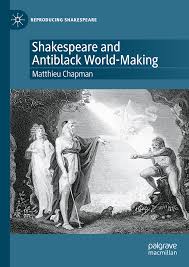
Matthieu Chapman
Shakespeare and Antiblack World-making
Palgrave Macmillan, 2025
186 pages
$129.99
Reviewed by Libby Hayhurst
Why should Black people care about Shakespeare? In Shakespeare and Antiblack World-making, Matthieu Chapman interrogates Shakespeare’s role in forming the universal “human” through practices of antiblackness, asking why black people should seek inclusion in Shakespeare’s Globe—or in the globe at large—when such inclusion relies on a performance of their own inhumanity. “Instead of assuming Shakespeare has value to everyone,” Chapman writes, might we ask why anyone should value a body of work that cannot be disentangled from the antiblack contexts from which it emerged and is sustained?
It’s a provocative question, and one with a surprising answer given its author Matthieu Chapman, a black scholar, actor, and director of Shakespeare. Building on the foundational work of Premodern Critical Race Studies (PCRS) scholars such as Kim F. Hall, Margo Hendricks, and Ania Loomba, Chapman brings early modern race studies into sustained dialogue with afropessimism. Taking on a mixed media format including movie script, storytelling, autotheory, and close reading, Chapman’s unflinching and irreverent second monograph will be of interest to readers seeking a deeper understanding of the evolution of PCRS, but will be especially pertinent to Critical Race theorists, and scholars committed to disrupting the antiblack violence embedded in the institutions and pedagogical practices through which Shakespeare is taught.
Chapman’s book is not arranged in chapters but in overlapping ‘times,’ yet nevertheless begins at an origin point of sorts: 1998. “Let me tell you a story,” Chapman begins. “In 1998, Harold Bloom fucked up everything.” So begins Chapman’s historiography of Shakespeare studies in which critics from Pope to Bloom declare Shakespeare the inventor of the ‘universal’ human. Chapman’s criticism of the ‘universality’ of Shakespeare is advanced in his second section in which he interrogates Ben Jonson’s declaration that Shakespeare is “Not for an age, but for all time” through a sustained analysis of Othello, Titus Andronicus, and The Tempest. Using Achille Mbembe’s theorization of time in which the colonized subject’s temporality is usurped by the colonizer, Chapman argues that Shakespeare’s black characters Aaron, Othello, and Caliban are severed from heritage, physically displaced, and exist suspended outside of time and context.
Building on his argument that the “untime” of black characters functions as a cultural touchstone for antiblack ideologies, Sections Three and Five examine how whiteness becomes legible through the negation of blackness, a symbolic opposition that the black body comes to occupy to stabilize emerging racemaking. His numerous examples, from Henry VI’s “black despair” to Lysander’s “out, tawny tartar, out,” provide evidence for his claim that Shakespeare’s characters are “telling a story of how the primary element of their humanity is that they are not black.” His argument, however, may be enriched by widening his focus to consider Shakespeare’s embrace of blackness in the dark lady sonnets. Chapman’s argument that whiteness is constructed in negative orientation to blackness is further advanced in Section Five by looking beyond the texts themselves to consider modern interpretation and performance. Diverse early modern identities (i.e. Protestant/Catholic, Irish/English), Chapman observes, are frequently collapsed into a generalized white identity in modern casting practices, while the presence of black bodies in roles not explicitly coded as black disrupt narrative coherence.
Chapman is truly at his strongest when he is arguing from the vantage point of the director’s chair and grounding his analysis in Shakespeare’s language. As such, Chapman’s argument reaches its fullest force in his interior chapters in which his observations work to disrupt both prevailing interpretations of Shakespeare’s works and foundational afropessimist theories by arguing for the paternal inheritance of blackness and challenging the idea that black “social death” originates with the transatlantic slave trade. Chapman’s sixth section, tightly focused on race and reproduction in The Tempest and Titus Andronicus, takes on the oft-neglected subject of Shakespeare’s representations of pregnancy by arguing that blackness is inherited paternally, a logic he extends in the following section by reading Sycorax’s union with the Devil as ontological miscegenation. Through this reading, Chapman successfully makes sense of the bedeviling fact that Tamora’s pregnancy goes entirely unremarked until the very moment of birth by deploying the concept of social death to posit that the black child is “produced absent the biological process of motherhood.”
Such deft nuancing of afropessimism is one of Chapman’s core strengths, even when these negotiations raise questions about hierarchies beyond the white/black dynamic. By reaching back four hundred years into the past, Chapman successfully locates one moment in which black social death occurs—not in the hull of the slaveship, but rather on the Elizabethan stage. Adapting the frameworks advanced in Frank B. Wilderson III’s Red, White and Black (2010), Chapman attends to themes of language and labor in The Tempest to identify Prospero as the “Master/Settler,” Ariel as the subaltern “Savage,” and Caliban as the black “Slave.” While Chapman emphasizes that Ariel occupies a denigrated form of humanity, he advances blackness as a distinct ontological category. In doing so, he refutes the argument that Caliban’s language has been “replaced” by that of the “Master/Settler,” advancing instead that Caliban lacks language before contact with the “Master/Settler,” a reading that is sharp and would be further strengthened by refuting that Caliban’s prior “gabble” constitutes language. Although Chapman’s reading of The Tempest is strong, his effort to distinguish antiblackness from other forms of racism potentially ignores how anti-Indigeneity may have likewise shaped English identity during American colonization.
In the final three sections of the book, Chapman reflects on contemporary responses to Shakespeare’s plays. In Section Eight, Chapman traces the evolution of Othello’s character from blackface performances to modern portrayals by black actors, using this history to characterize modern reproductions as an avenue for white audiences to project and alleviate their own racism. Although Othello may be the most frequently-critiqued example of antiblackness in the bard’s works, Section Ten turns unexpectedly to A Midsummer Night’s Dream where, through his own struggle as a director to identify and address encoded racism in the play, Chapman comes to realize how even in the absence of black flesh, a rift between blackness and humanity emerges in Lysander’s denunciation “Away, you Ethiope!” While A Midsummer Night’s Dream famously probes the boundaries of human desire and sexuality, the play treats the mere idea that blackness could be desirable as abhorrent. Taken together, these sections demonstrate the value of a perspective beyond that of traditional text-oriented scholarship; uniquely equipped as both a Shakespeare scholar and a director/actor, Chapman uses pain points in performance to pinpoint antiblackness in the text while revealing how blackness is enacted on stage in ways literary analysis alone cannot capture.
Expanding on these explorations of audience and affect, Chapman’s final chapter turns to our present political moment to examine contemporary stagings of Julius Caesar, contrasting an Obama-era production in which a black Caesar is brutally assassinated to a 2017 reproduction depicting the assassination of Trump. The disproportionate public outrage over the Trump production underscores how the dismemberment of white flesh is experienced as a violation of humanity, whereas violence against black flesh results in affective distortion, rendering black suffering unreadable.
Matthieu Chapman’s Shakespeare and Antiblack World-making excels at diagnosing the pervasive antiblackness embedded in Shakespeare’s texts and its role in erecting racial hierarchies, but his work stops short of proposing a path forward. For Chapman, Shakespeare can never be decolonized; not only is he the master, but he is “both the tools and the house.” “Shakespeare,” Chapman tells us, “will not save us.” If this conclusion is unsettling to the reader, it is profoundly disquieting for Chapman. “I can’t help but wonder,” Chapman concludes, “Was writing this book the best use of time and energy in this moment? […] Was reading it the best use of your time in the moment? […] Should I have spent these thoughts on revolution?”
I don’t have an answer, but what I can say is that Matthieu Chapman’s Shakespeare and Antiblack World‑making offers a bold and courageous reckoning that both Shakespeare studies and society urgently need. I write this as Operation Metro Surge, a massive ICE operation, descends on the Twin Cities following the president’s characterization of Somali immigrants as “garbage.” On February 12, I opened my email to discover that my home institution announced the consolidation of gender and ethnic studies departments in another unmistakable retreat from diversity. In the midst of this relentless assault on humanity, Sir Ian McKellen appeared on The Late Show with Stephen Colbert to deliver a heart-rending reading from Sir Thomas More demanding we confront the inhumanity we are complicit in. For Chapman, I have no doubt, it would not be enough. And he is right. Shakespeare will not save us, but neither will despair. Perhaps that is where we must begin: not with the hope that Shakespeare can be redeemed, but a recognition that Shakespeare’s stage remains one of many on which the struggle for justice might be fought.