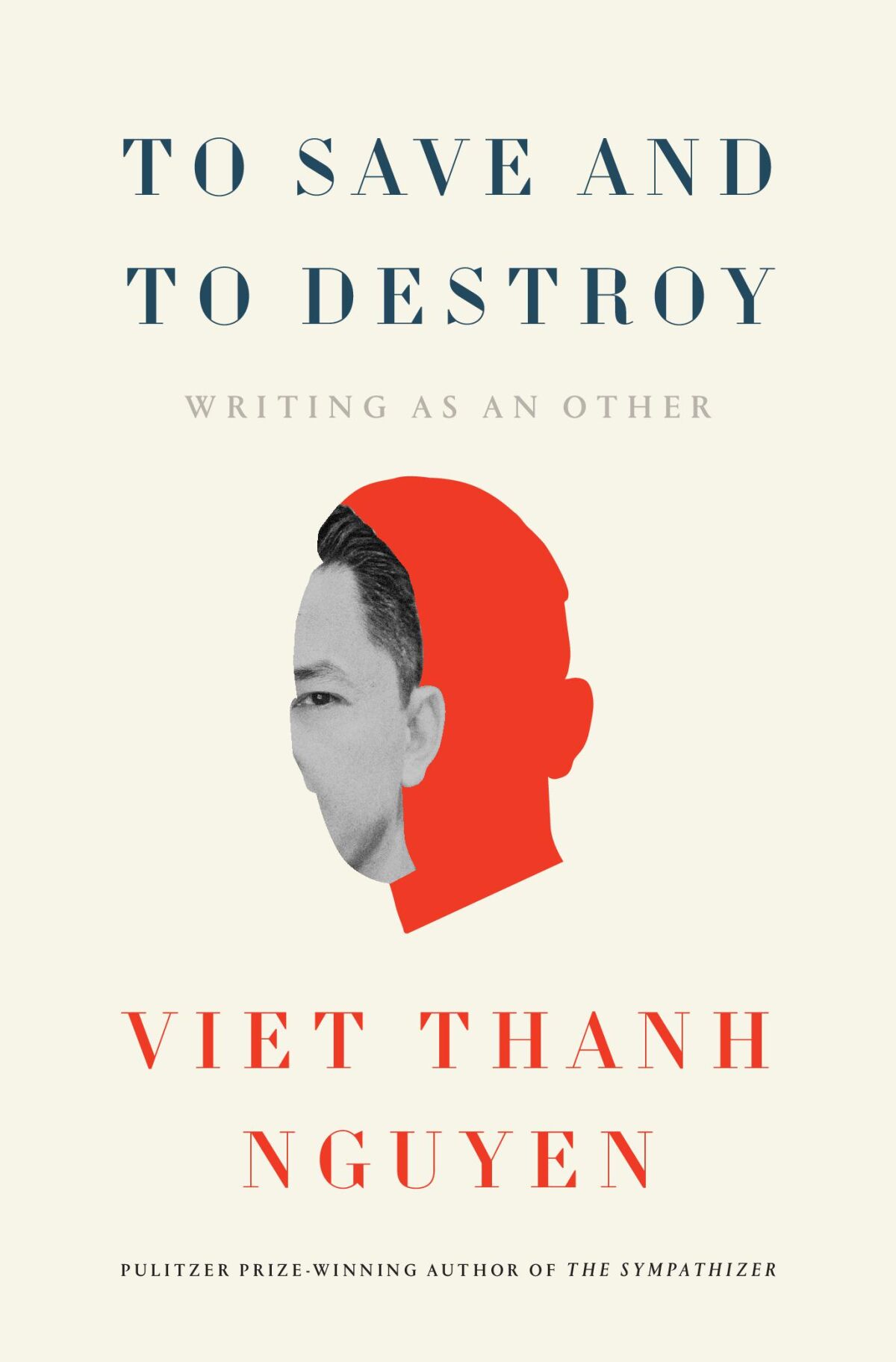
Viet Thanh Nguyen
To Save and to Destroy: Writing as an Other
The Belknap Press of Harvard University Press, 2025
126 pages
$26.95
Reviewed by Khoa Nguyen
What is the affordance of aesthetic representations of refugees? Does it even make sense to speak of a refugee aesthetics? Certainly, refugees are not meant to be beautiful. Refugee life is not considered beautiful. The refugee has been read as an abject figure in need of humanitarian assistance to move beyond this condition or as a critical subject position that gives lie to the ideologies of modern liberal sovereignty, but rarely as a site of aesthetic fecundity. Scholars of ethnic and refugee literature are usually critical of the aesthetic, for notions of beauty are often formed by processes of political power and cultural hegemony that exclude marginalized and non-normative subjects and bodies. Worse, the aesthetic can fashion horrific atrocities or conditions as pleasing spectacles that draw attention away from the material conditions of the refugees who live in those destitute scenarios. What, then, does refugee aesthetics offer for refugee politics? This question is the central concern of Viet Thanh Nguyen’s To Save and to Destroy: Writing as an Other.
Originally delivered as a series of six Norton Lectures, Nguyen’s autotheoretical essay collection draws on his family’s history of arriving and settling in Southern California as refugees of the Vietnam War, but also on close readings of fiction and poetry and theoretical strands of critical refugee studies, to deliberate what it means to write as ‘an other’ about ‘the others.’ For Nguyen, the other is a flexible analytic that subsumes different, at times contradictory, modalities of exclusion and alienation across the six essays. Because the essay collection originated as relatively self-contained lectures, it is appropriate to offer a preview of Nguyen’s arguments within each essay rather than an overview of the book’s overarching argument.
The first two essays approach the difficulty of representing refugee lives from the vantage point of a writer, outlining the promises and pitfalls of creating literature about the subjects that undergo otherization, “those who are outcast from or exploited by the powerful norm of their societies, or those who have moved voluntarily or have been moved forcefully from one place to another.” Nguyen lays out three rhetorical strategies for representing the other and their limits. The first is to “idealize and sentimentalize,” or, to turn the other into a moral paragon or perfect victim. Given how marginalized subjects are distorted and dehumanized in literature not written by them, the impulse to defend oneself symbolically by highlighting one’s innocence, vulnerability, and victimhood is understandable. Yet this impulse also limits the range of potential representations to sanitized, flattened images of the other as pure passivity. The second is to “separate oneself from the herd” by cutting ties with the otherness that is imposed by external forces. However, insisting on one’s agency risks replicating the very logic that excludes oneself onto a different other, thus becoming a victimizer in turn. The third is to treat one’s community, which has hitherto been marginalized, as sacred, thereby taking on the responsibility of telling “idealized, sanitized, or stereotyped stories about their community.” However, doing so risks calcifying one’s identity, or treating one’s traumas and injuries as exceptional. As a remedy, Nguyen suggests it is necessary to inhabit a mode of writing capable of expanding one’s grief rather than reducing it to a singular sorrow, for “capacious grief acknowledges that the trauma of the other is neither singular nor unique, that there are other others out there with whom we can share the burden.”
The third essay addresses the problematics of capacious identification across social groups and communities to argue for the necessity of Asian solidarity with Palestinians. Nguyen notes how, although Edward Said’s Orientalism has “provided much of the intellectual energy that drove the growth of Asian American literature and culture,” Asian American politics have not wrestled with the significance of the occupation of Palestine and genocide of Palestinians, despite both groups having been maligned under the term ‘Oriental.’ This reflection prompts an examination of how Asian American politics have been organized. To seek self-defense, Asian Americans have demanded inclusion into the larger polity of the nation that excluded them. This inclusion requires solidarity, as those who have excluded others now extend hospitality to the excluded, while the excluded simultaneously need solidarity among themselves for political organization. However, a limited solidarity allows selective inclusion to some marginalized groups while perpetuating the exclusion of the rest. What is necessary, Nguyen argues, is a capacious and expansive solidarity, a solidarity with “whoever is the cockroach, whoever is the monster.” From defending oneself to demanding inclusion for those like oneself, one should be able to recognize the demands of the other others who remain excluded.
The second half of the collection turns to the issues of form and reception as they pertain to refugee literature. The fourth essay questions the adequacy of literary realism as a form for depicting refugee lives. Given how refugeehood is haunted by a multitude of deaths (social death, living death, death of one’s relatives, etc.), Nguyen contends that literary realism cannot comprehend or represent the scope of death that refugees undergo. Through close readings of the works of Gloria Anzaldúa, Theresa Cha, and Behrouz Boochani, he argues that what is necessary is an aesthetics that is decidedly surrealistic, even absurd, capable of fully accounting for both the incomprehensible and the quotidian nature of death in refugee lives. Embracing surrealism and the absurd, this chapter deliberately breaks with the predominant reading practice of ethnic studies and critical refugee studies that frames literature’s importance in terms of sociopolitical diagnosis and anti-hegemonic self-expression. Instead, Nguyen asks us to consider that, when wielded with intention, refugee aesthetic forms can map the alternative positions refugees hold in the cultural imaginary and everyday life by intoning and performing different ways of being, belonging, and feeling.
The fifth essay probes how writers from marginalized positions are inevitably read as ‘minor.’ To be read as belonging to minor literature means that one’s works are confined to the realm of the personal or the political in contrast to the major literature of the empire “that does not identify itself as a genre, but instead aspires to an invisible, unmarked university.” Rather than desiring the position of a major writer and denying one’s status as a minor writer, he contends that a more efficacious form of resistance is embracing one’s minor position, “appropriating the documents of American empire, subverting its language from inside” and giving lies to the universality of the major literature. The final essay, “On the Joy of Otherness,” adopts an autobiographical mode to examine how otherness is simultaneously a source of alienation and enjoyment, drawing on memories of Nguyen’s family’s separation and reunion.
The essay collection traverses a wide range of themes and problematics in relatively few pages. Some readers might lament the text’s brevity and wish for more thorough, theoretically rigorous expositions of certain topics. On the other hand, because it is written in highly readable prose punctuated by liberal use of personal history, the essay collection is immensely teachable. Nguyen’s focus on the capacity for synthesis, whether by representing expansive grief or by imagining capacious solidarity, marks a clear departure from prior theorization of refugee literature as one that resists power or does memory work. What theoretical grammars and conceptual frameworks are needed to access these synthesizing affordances of refugee literature? Nguyen’s essay collection does not provide an answer, but it is a good place to start thinking about this question.