Lesley A. Wolff
Culinary Palettes: The Visuality of Food in Postrevolutionary Mexican Art
University of Texas Press, 2025
240 pages
$55.00
Reviewed by Lauren Schilling
Lesley A. Wolff’s Culinary Palettes: The Visuality of Food in Postrevolutionary Mexican Art investigates the relationships between foodways, visual culture, and emerging post-revolutionary Mexican national identity in order to clarify the ways in which food and art are not merely pieces of heritage but rather active ingredients that construct emergent national identity. Wolff constructs a clear argument through case studies that complicates formations of Mexican national identity in the post-revolutionary era. At its core, the interventions in Culinary Palettes illustrate how images convey the visibility and mobility of foodways by analyzing labor, cookery, gender, and shifting racial identities.
To orient the reader to Wolff’s central argument, she first introduces key terms that are integral to deciphering her interdisciplinary approach. Referring to Roger Bartra’s analysis of where modernity and coloniality intersect, Wolff deploys Bartra’s definition of desmadre—a Spanish term signifying something as wild, outlandish, or disorderly. By reading the term in a gendered context, Wolff suggests that desmadre is the “unmothering of the nation, supplanting a sense of nurture and care with a patronizing hunger and lack.” Desmadre remains a key term throughout the book, especially when she considers her guiding question about how cookery and consumption embed themselves into visual culture, the creation of a national identity, and the visibility (or invisibility) of social struggles in the Mexican post-revolutionary period.
Each chapter follows one key artwork and one foodstuff. Chapter One, “Bebidas” (drinks), closely follows Italian expatriate and artist Tina Modotti’s 1926 photograph Baby Nursing to argue that the photo is not only a site that questions the role of motherhood in the emerging nation, but it also evokes the consumption of pulque—a drink with roots in elite pre-Columbian rituals that later becomes associated with the working class. Wolff uses Modotti’s photograph to analyze a connection between breast feeding and Indigenous nursing practices, which were seen as unhygienic, and similar conceptions of agricultural laborers producing pulque, often done through the tlachiquero, who nurses sap from agave plants. The consistent visual analysis exists alongside pointed cultural analysis that investigates who gets to claim Indigeneity or the newly-forming Mexican racial identity.
Chapter Two, “Guisos” (stews), follows mole poblano, a dish that evolved in the colonial era as a fusion between native and transatlantic ingredients, and Carlos E. Gonzaléz’s large-scale painting The Creation of Mole (1946). Described as an under-analyzed artwork, Wolff attests to the artwork’s importance because it emphasizes how the shift from post-revolution to industrialization racially encoded labor, leisure, and nationalism. Here, the foodstuff and the artwork work hand-in-hand to convey how mestizo nationalism was produced through “racialized and gendered processes of visually and gustationally ingesting Mole Poblano.”
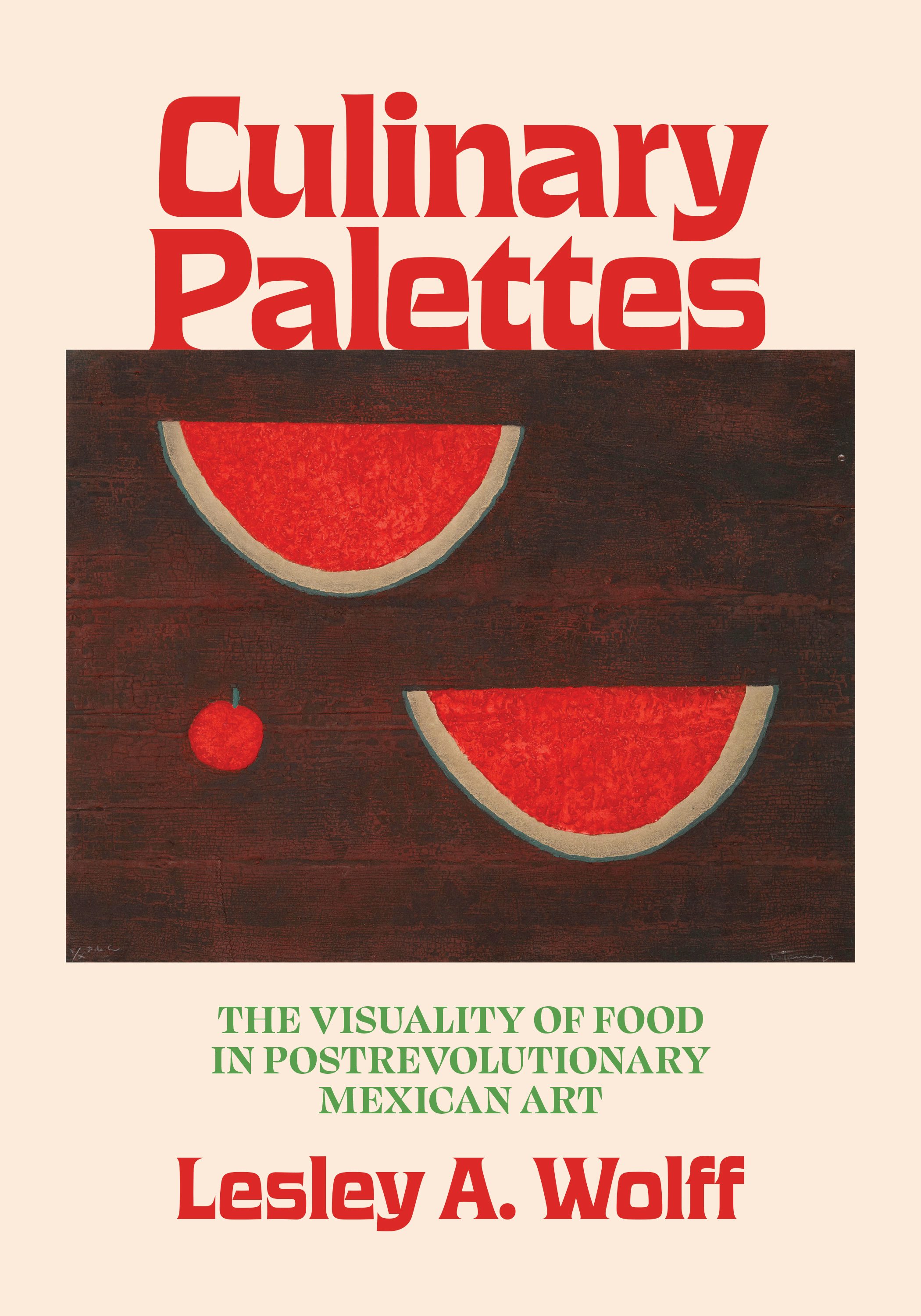
Chapter Three, “Frutas” (fruits), investigates Rufino Tamayo’s mural Naturaleza Muerta (1954) to question how the sandía (watermelon) became a signifier of the Mexican flag as the transatlantic migration of the watermelon from Africa became invisible. Within this chapter, Wolff expands the argument into global transatlantic analysis, combining the history of the transatlantic slave trade with the sociohistorical context of anti-black racism in Mexico. The watermelon is also a symbol of desmadre, as the mural was commissioned by Sanborns, a US based department store, showing the rise of industrialization and globalization. A key intervention in this chapter names the sandía a site for nostalgia that creates notions of a fictitious Indigenous past as well as an anxiety surrounding informal economies such as fruit vending in industrialized urban settings like Mexico City. Within this context, Rufino Tamayo’s positionality as a person with Zapotec heritage who grew up seeing fruit vendors in Oaxaca becomes an important addition to Wolff’s analysis.
The conclusion, “Bocadillos,” connects the historical case studies to present-day Mexico City. The conclusion centers chef Enrique Olvera’s dish Mole Madre to demonstrate how the dish is imbued in traditional heritage and refined haute cuisine. Wolff analyzes Mole Madre through Guillermo Bonfil Batalla’s idea of two Mexicos: one that imagines the Mexican “Indian” as something of the far past, and the “imaginary Mexico” that is made up of the mestizo elites. Not only does this conclusion harken back to the second chapter, “Guisos,” it reinforces how visual legacies and foodways inform and construct conceptions of heritage.
To make meaning of these ideas, Wolff utilizes an interdisciplinary approach to analyze the intersections of foodways and visuals. Pulling visuals from artworks, postcards, illustrations, and other encountered sites, she pairs the visuals to pieces of material culture such as cookbooks, food ingredients, and acts of cookery to cumulate an archive of evidence. Alongside these pairings, or case-studies, she intertwines methodologies from scholars working with visual history, food studies, art history, race & ethnic studies, and gender studies, among others. In the process, Wolff explains this web of interdisciplinary connections as necessary to understand the “critical framework of heritage-as-food.”
Food studies in relation to visual culture and art history is an ever growing site of academic inquiry. Drawing upon Shana Klein’s book Fruits of Empire: Art, Food, and the Politics of Race in the Age of American Expansion, Wolff continues to contribute to the expansion of what defines an art-historical method by incorporating more intersectional insights than traditional examples of art history that leave out critical studies of identities and nationalisms.
The book’s primary audience is geared towards the fields of art history, food studies, and critical identity-based studies such as Latinx/o/a Studies, Transatlantic studies, and other related fields. While this is a scholarly work, Wolff creates an engaging text and the complementary visual analysis offers an entry point for those outside the academic setting to engage with this work. Wolff’s thoroughly researched, consistently analyzed work offers a new insight into how visual culture can successfully analyze facets of national identity formation, intersectional identities, and the lasting legacy of foodways