Sophie Chao
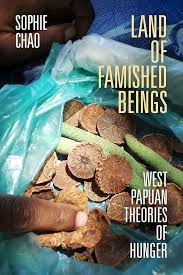
Land of Famished Beings: West Papuan Theories of Hunger
Duke University Press, 2025
272 pages
$28.95
Reviewed by Paige Welsh
When I picked up Sophie Chao’s Land of Famished Beings: West Papuan Theories of Hunger, I was not expecting to learn about an ongoing genocide through deforestation. Chao does not announce that this is the direction of the book for good reason. Land of Famished Beings is an anthropological text about hunger that seeks to elucidate the Marind people of West Papua’s emic conceptualizations of hunger. Beyond a quantifiable sense of malnutrition as a shortage of calories or nutrients, Marind people understand a plurality of hungers that unfold relationally in the more-than-human world. Eating and hungering are processes with ethical implications. They are aspects of human situatedness in the forest the Marind people draw sustenance from. However, encroaching corporate settler colonialism from the palm oil industry is a more recent and seemingly insatiable hunger that eats the land and the bodies of the Marind.
Chao works to platform Marind women’s theories of hunger and consumption through a methodology she calls “hesitant anthropology.” She presents what she witnessed in her year and half living alongside Marind women with careful awareness of what an academic text can and cannot do. Her informants are her co-theorists, and Chao presents them as complex people navigating complex problems. Still, Chao is an activist scholar who presents the harms of pollution, deforestation, and state violence at the ambivalent request of her collaborators. You cannot know hunger from reading a book, but you must know there is hunger, and ours is implicated in an interwound world.
Chapter One introduces the reader to the Marind concept of hunger alongside their understanding of satiation. To quote Marcella, a Marind woman who led Chao, “If you want to understand hunger in the village, you must first understand satiation in the forest.” Satiety (kekenyangan in the Marind language) is born of the exchange of vitality with animals, plants, and other humans in and among the forest. This vitality also goes hand in hand with knowledge (ilmu) of the forest and respect for the freedom (kebebasan) of its beings. The Marind certainly hunt, but they do so with consideration for whether animals are at the appropriate stage of life and whether taking that life feels right amongst a range of factors. They also move and seed plants as crops for themselves or game like pigs or cassowary. The discerning and balanced exchange of the wetness of life, be that saliva, blood, perspiration, rivers, or sap from a plant, generates satiety. Beyond being literally full of nutrients, satiety comes out of eating and feeding the more-than-human world with reciprocity.
The introduction of industry in West Papua, namely the cultivation of palm oil, has introduced hungers to Marind life that seem bottomless. In Chapter Two, Chao briefly outlines the history of colonization in West Papua. Dutch colonization in the twentieth century brought missionization and Christianity alongside the unrestrained hunting of birds of paradise for their plumage. In the 1960s, Indonesia took over West Papua and dramatically reduced the indigenous people’s access to their ancestral territories through militarization and corporate occupation. Settlers and the Indonesian government have blamed the resulting famines on the failures of Papuan women rather than the loss of forests. Although it is Papuan men who broker contracts to sell the land in exchange for cash and goods, women often weather the indignity of waiting in line for unsatiating “plastic foods” like cookies and ramen promised through corporate responsibility initiatives. Papuan women who go to Indonesian health clinics also experience overt racism from healthcare workers who blame malnutrition on the foods of the forest rather than the meager, ultra-processed rations. As the forest gets replaced by plantations, the Marind must participate in the new economy which spurs ever more new hungers for cash and the goods it can purchase.
In addition to experiencing new hungers, the Marind women theorize that they are being eaten by new forces. Chapter Three discusses the hungers of roads and cities. Although the Papuan government has advanced roads as a benefit of economic growth, Marind women encounter the roads as sites of danger whose vehicles ravenously consume animals and humans alike. Since they are extremely unlikely to ever drive, let alone possess, a car, the road either kills undiscerningly or takes men to the city. Sometimes, if they encounter an animal that has died or is dying violently, the Marind women stop to grieve a pointless killing that satiated no hunger. Choa notes, “the form of dying here matters as much as the fact of death itself.” Cities also pose the danger of sexual violence at the hands of Indonesian and Papuan men alike. Between witnessing death on the road, racialized and sexualized violence in the city, and ways corporations seem to manipulate men into ceding land, Marind women are skeptical of the purported benefits of “development.” Rather the government and capitalism are another force of hunger that consumes without satiation.
Chapter Four maps how Marind women theorize the hunger that eats at their community as a sign in moral relations. Should hunger be considered a sign of victimhood, martydom, or moral failing? Choa’s informants share a range of beliefs inflected by both beliefs in ancestral punishment and Christian sacrifice. Questions of blame also circulate around how Marind men seem to suddenly sign away the land when they negotiate with corporations in the city. Are the men to blame or are these corporations tilting the field of negotiation? Regardless, women carry much of the pain, and some read a Christ-like sacrifice into their experience. Others look at their situation with a structural critique of the international community that has looked away from their starvation and the destruction of their forest. As Chao summarizes, “In Marind ecologies of hunger, culpability multiplies across diffuse scales and subjects that resist reduction to any one particular entity.”
Chapter Five and the Conclusion reflect on the difficulties of writing about hunger. Chao relates the story of Mina, a child who died of hunger while Choa was with the Marind, and her family’s difficult decision to give Choa permission to write about the death. They wanted the severity of their situation to reach a wider international audience, but they do not want to be reduced to objects of pity. Eventually Mina’s grandmother permits the account on the grounds that Choa writes “why this book shouldn’t exist.” Choa goes on to point out how we as researchers and readers are consuming these stories, but they should leave us with indigestion. There is no innocent eating. You, reader, are likely consuming palm oil that in turn consumes the land of the Marind and the people themselves. We consume Choa’s account with great intrigue for the Marind way of life, but we also digest it uneasily. There’s genocide in Papua you may have never heard of, and you may be eating its fruits right now. It is an unsatiating realization, which makes Choa’s project a solemn success.