Francisco E. Robles
Coalition Literature: Aesthetics on the Move in Midcentury US Multiethnic Writing
Stanford University Press, 2025
296 pages
$35.00
Reviewed by Halley Roberts
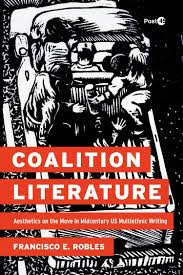
Writers in and beyond academia have long-preserved habits of reducing distinct human experiences to archetypes. It’s convenient, after all, to dilute individual difference into symbolic categories and, inversely, to allow those categories to dictate the lexical tools available in conversations about difference. However, as Francisco E. Robles suggests in his recent book, all writers, readers, and thinkers are exposed to a risk when we rely on a “touristic reading” of multiethnic literature. In Coalition Literature: Aesthetics on the Move in Midcentury US Multiethnic Writing, Robles traces the evolution of coalitional aesthetics from the 1930s through the 1980s. He elucidates writers’ and activists’ shifting, intentional drive to resituate the “I” of lived experience into a “we” of unified difference. By attending to the evolution of the “we” within a transhistorical collective, Robles invites his readers to consider not only how individuals and groups “tell a story” about the past but also how all people must necessarily make meaning with stories of difference. Pivotal to Robles’s approach is a sustained focus on a “we” traceable across midcentury multiethnic writing. This “we” that enacts “speaking with,” (Robles’s italics) a term Robles develops to denote the communal aesthetic’s relational and intergenerational function. The “we” is a deliberate aesthetic choice with which writers reinforced a coalitional ethos—one that evolved significantly over the decades, but was always governed by a writer’s desire to speak with.
In Chapter One, Robles compares Muriel Rukeyser’s documentary poetics in The Book of the Dead (1983) and Zora Neale Hurston’s ethnographic histories in Mules and Men (1935). According to Robles, although Rukeyser and Hurston attempt distinct projects rooted in their perspectives, both equally “insist on the irreducible complexity of the lives they represent on the page,” an insistence that hinges on both writers’ willingness to imagine the people around them beyond the essentializing categories dictating other authors’ representations. Circumventing trope, genre, and ideology, Rukeyser and Hurston were initiators of the aesthetic coalitional ethos Robles foregrounds. For example, Robles examines the term “folk” as a convenient byword for an American identity in and of itself; in contention with this term, Hurston’s writing, which invokes the “we” of a predominantly-black migrant “folk” workforce, gives vibrant life to her speakers by letting contradictions exist within the text. Hurston speaks with a community that is whole and undefinable, real as it is veiled by disruption. The history of the Popular Front, and its corresponding aesthetic turns, is a vital context for understanding the necessity of both individual difference and shared community in coalitional activism, and for understanding how these efforts evolved into the liberal ideal of multiculturalism. The differences that define us are not opposition to one another, but rather, difference is a necessary ingredient for distinct rather than representational identity.
In Chapter Two, Robles pivots to musician Woody Guthrie and author Sanora Babb to situate coalitional aesthetics in another migratory context centered on the impact of the Great Depression and Dust Bowl. Claiming imagination as a vital praxis, Guthrie and Babb write a situated whiteness that speaks with and not for coalitional visions. In particular, Guthrie (in his music) and Babb (in her writing) are “speaking with” laboring and migrant masses to destabilize the nationalistic image of the poor white farmer that America came to associate with agriculture, labor, and migration in light of mid-century economic decline. Guthrie and Babb’s coalitional processes situate whiteness in direct affiliation with improvisational meaning-making. Through a shared investment in American migrant communities, “Babb and Guthrie crack open the limitations of aesthetic representation by crafting an aesthetics of affect,” a process that invites the reader (for Babb) and listener (for Guthrie) into a shared sense of belonging, a chance to see oneself speaking with (and not just being spoken to) them both.
Moving into the 1960s, Chapter Three spotlights the Memphis Sanitation Strikes and literature that developed out of the movement. Focusing primarily on the strikes, which are characterized by the transference of theological struggle onto racial and class turmoil, Robles troubles the cultural imaginary of 1968, particularly as it pertains to the assassination of Martin Luther King, Jr. The poetic and aesthetic tradition that emerged from the strikes was not a local byline hidden behind this tragedy, Robles argues, but in fact carried global import beyond the tragedy, import that resituates the significance of Black Nationalism, liberation theology, civil rights, and more. The strikers, as Robles suggests, continued the tradition of “speaking with” by adopting theological forms that invite interlocutors to look beyond the trauma of that year and, instead, see the work as a testament to communities advocating for (and living in) freedom. Robles contends with the mistaken-but persistent-conviction held by many institutional thinkers that mere representation accounts for the multidimensional peoples, histories, and contexts that intersect across various lives.
In Chapter Four, Robles details the “totalizing and discursive structures of allegory,” employing Tomás Rivera and Carlos Bulosan’s work to explicate a new term: the “migrant pizcaresque.” The migrant pizcaresque is a challenge to strict genre containers; it reveals the limits of allegorical genres to account for coloniality, imperialism, and displacement in migrant stories. By Chapter Five, Robles moves this conviction into the 1980s as the “more or less inevitable transition of the aesthetic strategies of speaking with, from a firm couching in coalition ethos of the long Popular Front to the multiculturalism of institutions, especially academic and political ones” occurs. In his final chapter, Robles challenges chronic assumptions about representative diversity by moving discourse about Cherríe Moraga and Gloria Anzaldúa’s anthology This Bridge Called My Back (1981) away from diversity as the end goal of academic inclusion (and Bridge as merely a vehicle by which scholars consider diverse experiences as oppositional to the status quo) and instead reflects on the anthology as an object.
Coalition Literature is many things: a compelling reorientation of midcentury literature’s relation to politics, a pedagogical primer for instructors teaching said literature, an invigorating counter-history of aesthetics, and more. It’s also a call to consider the recovery of political movements with internal variance. Robles offers a refreshing opportunity for both scholars and writers outside academia to consider how aesthetics, narrative, and genre generate meaning. Aesthetics is characterized by Robles as vital, breathing difference; aesthetics includes processes by which writers and activists enact a coalitional ethos that lives and moves via encounter and process. Process, Robles ultimately concludes, is the key to meaning-making in vibrant community: not product, as many institutional thinkers have assumed. At the heart of Coalition Literature is a seemingly-simple invitation that readers from all disciplines should take to heart: resist the impulse to dilute our understanding of life into totalizing genres of knowing, genres that invite us to narrow our scope according to the size of available archetypes, when a wholly vibrant world is coming together around us, making meaning moment by moment, in process and never stasis. Robles reminds his readers that there is much at stake in our reading of the world and in our reading of ourselves.