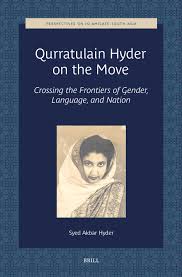
Syed Akbar Hyder
Qurratulain Hyder on the Move: Crossing the Frontiers of Gender, Language, and Nation
Brill, 2025
375 pages
$25.00
Reviewed by Tushar Srivastava
Syed Akbar Hyder’s pioneering work on South Asian writer Qurratulain Hyder is fascinating and monumental in more ways than one. Fredric Jameson laid out the methodological paradigm of national allegories while talking about third-world literature. Akbar Hyder brings into this conversation a major Indian writer primarily writing in the Urdu language, by studying her reportage writings. In doing so, he complicates the nuances of such allegories and raises the stakes of scholarship involved in studying these “third-world writers” for both the fields of world literature as well as cultural histories. He goes beyond the popular canonical reduction that often compartmentalizes women writers to a single literary genre.
Hyder explores Qurratulain Hyder in three ways. First, he draws from a rich set of archives, including personal interviews, to explore the dense, fresh ways in which the mind of a writer works. This is the first space where Qurratulain Hyder creatively transforms her experiences and the violence of everyday life. Second, he situates her in a long and rich tradition of writers, texts, and tropes in the Perso-Urdu register, as well as the Indic and Islamicate world, from which she writes. Qurratulain Hyder engages these tropes in new ways, reminding readers of the ways in which writers are in conversation with longstanding cultural traditions and notions of subjective universality. The supposedly ‘modern’ impulse to break from the past is not only bereft of the rich ideas and devices literary traditions offer, but also does a disservice to the author herself, who is informed and educated by those traditions. Third, the book historicizes Qurratulain Hyder as a postcolonial writer. Her writings sit at a cusp of Indian history where the recto of colonial subjugation has flipped into the verso of independence and self-rule. It is at this juncture that dichotomies of good-evil, fair-unfair, and violent-peaceful are all stripped naked, and the burden of historical action is transposed from the tyrant other to the lacking self. Frontiers are crossed.
Chapter 1, “Dance of a Spark,” not only introduces Qurratulain Hyder on the literary scene but also establishes that introduction as an act of interfluence. The scholar begins with Hyder’s colonial context and legacy, including Hyder’s father’s fascination with Turkey as a model relevant to colonial India. Growing up, Hyder’s world is of both “captivity and privilege.” The chapter also situates the women who influence Hyder’s childhood and imagination—she was named after the Iranian poetess and social activist Qurratulain Tahirah. Hyder analyses Qurratulain Hyder’s essay on London, ‘London’ (1940); her piece Mere Khyal Men (In My Opinion), which comments on aesthetics and literature at a time when Marxist realism and representation compelled writers globally; and her first novel, Mere Bhi Sanam-khane (My Idol-Houses Too, 1949). The chapter then moves to India’s partition and Hyder’s post-partition move to Pakistan. Finally, Hyder introduces her magnum opus, Aag ka Darya (River of Fire, 1959). Not only does the chapter situate Qurratulain Hyder within her historico-literary context, Akbar Hyder also establishes her commitment to religious pluralism and polyvocality at a time when deterministic lines were drawn between religion and language, and the community was literally partitioned.
Chapter 2, “Hyder’s London and Reflections of Home,” turns from Qurratulain Hyder’s novel to her reportage. In 1952, she set out for London with stops in Baghdad, Beirut, Istanbul, Frankfurt, and Brussels. In her travels and subsequent reflections, Hyder explored her identity through defiance. Her writings defy genre, as she richly drew from a bricolage of influences. Her reflections defy positivistic accounts of history, and instead of being starstruck by the charms of London, she explores the “underbelly of the city” and its subaltern workers. Chapter 3, “When Prisoners Were Freed, Times Had Changed,” looks at the themes of memory, history, and identity in Hyder’s reportage on the prison. Her interpretation of the colonial legislature as a prison broadens the concept of incarceration. She focuses on the prison of Andaman, the notorious carceral-colonial institution with which she has a contentious relationship. She partly grew up there, as her father was posted as a British civil servant to the Andamans and in the other; but as a colonised subject herself, she witnessed the imprisonment of Indian revolutionaries. Years later, in 1961, she encountered the brother of one Andaman prisoner, Sudhir Kumar Bose, but the encounter was interrupted by ‘beatniks’ at an exotic music conference exoticizing and flattening their memories of the prison. As the author aptly argues, in Qurratulain Hyder, we find a scathing critique of culture vultures.
The crowning jewel of this book is Chapter 4, “Tumult Rises in the Prison.” The chapter works through the ambiguous, yet powerful genre of the alam ashob (the world’s grief). Akbar Hyder invokes Benjamin’s angel of history to contradistinguish its solitary spectatorship against the power of collective mourning in the face of violence. The banal violence of everyday existence is stretched to two ends in Qurratulain Hyder’s alam ashob, which is in turn located in the tradition of Urdu elegiac poetry known as the marsiyah. On one hand, alam ashob turns to the past and its motifs, figures, and traditions to develop on the intensity and dimensions of such violence, with the martyrdom of Imam Hussain in the Battle of Karbala serving as one of the many starting points. On the other hand, the globalisation and desensitization of late twentieth-century politics is woven with precision to deliver a distinctly modern taste to this tapestry of interwoven historical injustices, in both Qurratulain Hyder’s writings, and Akbar Hyder’s analysis of the same. As the latter powerfully puts it, “When the narrator asks who has brutalized the new generation into lovers of death, we are not meant to supply the answer, we are the answer.”
True to its name then, the book crosses boundaries of genre, form, politics, and identity fixation. Akbar Hyder makes a case for crossing the boundary between prose and poetry by fusing both in his explication and analysis. Yet, he does not elevate Qurratulain Hyder to a hyper-human figure, and rather works with her limitations, historicizing the author as a product of time, capable of crossing boundaries with her literary prowess. Ultimately, he raises two important themes for the scholarship on colonialism, nationalism, and cultural capitalism. First, the challenge of exploring Urdu literary discourses within the imperial categories that subjugate those discourses in the very first place. Second, the importance and centrality of the figure of the writer in any study of historical time. As the epilogue cites, Qurratulain Hyder as a child very aptly wrote,
qalam goyad keh man shaah e jahaanam
qalam kash raa bah daulat mi rasaanam
The pen speaks: “I am the ruler of the world
I lead the one wielding the pen to power.”