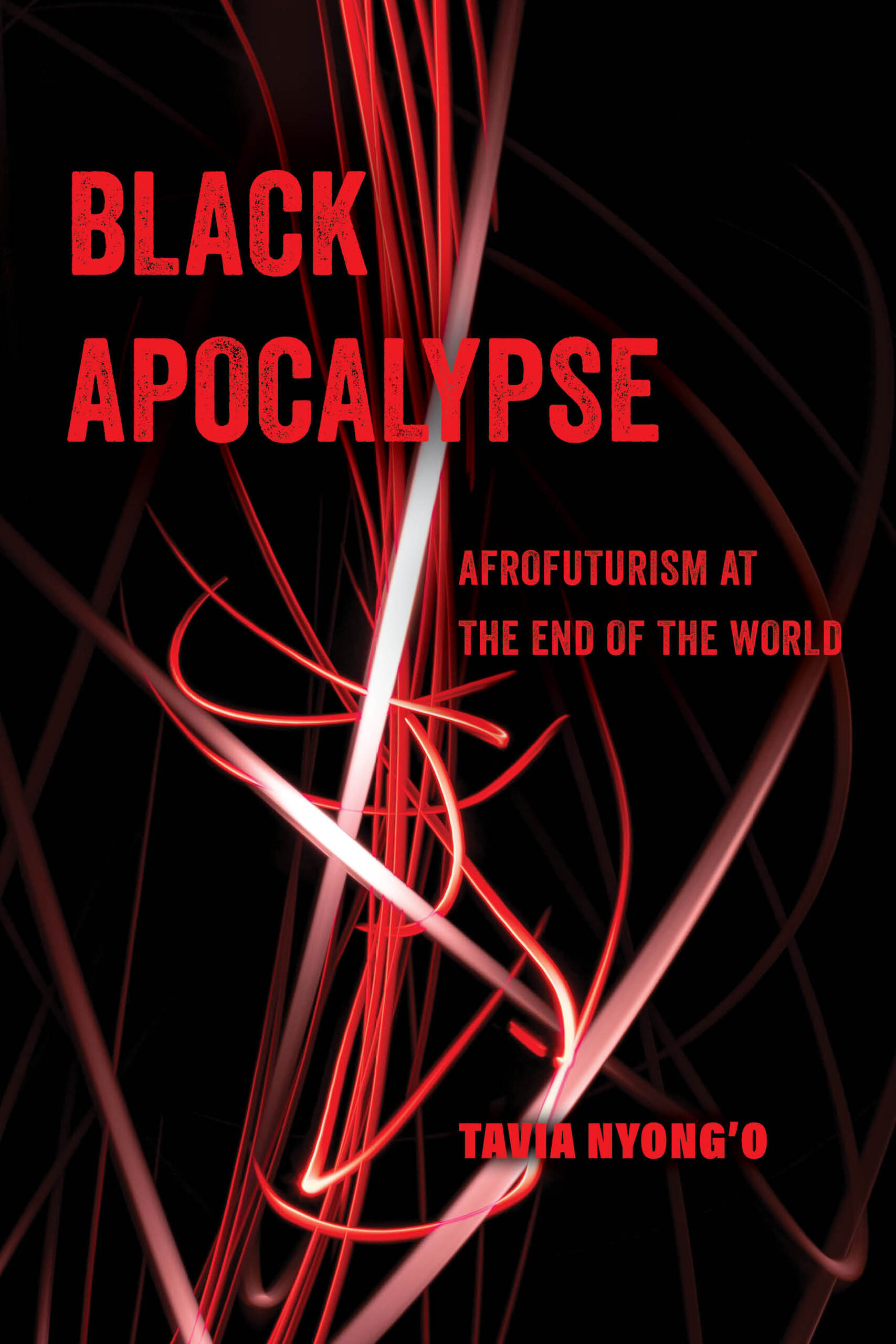
Tavia Nyong’o
Black Apocalypse: Afrofuturism at the End of the World
University of California Press 2025
136 pages
$18.95
Reviewed by Shannon Potter
Tavia Nyong’o’s Black Apocalypse: Afrofuturism at the End of the World provides a revelatory framework for understanding the necessity of imaginative work in the political pursuit of black liberation. Expanding his previous work on “afro-fabulation,” Nyong’o theorizes the connections between afrofuturism and afropessimism, characterizing both as forms of “black counter-speculation” that disrupt antiblackness by imagining worlds otherwise. Interweaving analysis of political rhetoric, black literature, critical theory, and black popular culture, Nyong’o’s work argues against understandings of “black speculative fictions, parables, allegories, and thought experiments” as mere escapism, challenging the “standard dismissive attitude” that marks utopianism as “a distraction from political struggle.” Rather, he claims that speculation in black political thought and aesthetic creation functions as “a disciplined practice” wielded in opposition to the antiblack realities that undergird contemporary sociopolitical infrastructures. Black Apocalypse belongs to the “American Studies Now: Critical Histories of the Present” collection, edited by Lisa Duggan and Curtis Marez. As such, it positions itself as a concise and accessible commentary on contemporary “teachable moments,” offering an introduction to the intellectual tools necessary to “think critically about allegories of futurity, end times, and new beginnings” rather than a comprehensive overview of afrofuturist or afropessimism works writ large.
As the longest chapter in the book, Nyong’o’s introduction helpfully lays foundations for his later arguments. Here he explains how “black life in America has long been viewed through an eschatological lens,” situating apocalyptic imaginations as both a pessimistic throughline asserting the fundamental antiblackness of modern democracy and a recurrent manifestation of life-affirming efforts to build alternative worlds. Black speculative thinkers, he claims, use apocalyptic rhetoric and narrative to embrace their “belonging to the planet and the universe” while disidentifying from “the civil and political infrastructure that created and sustain[s] white supremacy and extractive capitalism on a world scale.” Methodologically, Nyong’o names the centrality of black feminist, queer, and trans critiques before noting the “incommensurability of the truth of the black experience.” He professes his investment in “conjectural thinking,” moving from “generational cohorts” or delineated “schools of thought” towards “entanglement and mutuality, however frictive.” Incorporating this collection of interdisciplinary influences, Nyong’o narrows his project by limiting the primary focus of his analysis to the epistemic shifts that defined the end of the twentieth and the first quarter of the twenty-first centuries, with attention to geopolitical, technological, and environmental changes.
Nyong’o’s first chapter, “The Virus is the Alien,” provides some of his most significant critical interventions. He contextualizes the fantastical works of Samuel Delany and Octavia Butler within a broader Afrodiasporic literary tradition, demonstrating the ways in which the political strategy of black counter-speculation extends beyond one literary genre. He shows that the explicitly science fictional or fantastical elements of some texts extend from a broader practice of creatively reimagining possibilities for black flourishing within violent and oppressive power structures, as through the processes of “cognitive estrangement” that characterize speculative works. Ultimately, he makes persuasive connections between the abstractions of creative imagination and the work required to craft concretely livable existences beyond the ontological boundaries of the human, particularly for those routinely excised from the protections of such a label.
Nyong’o also compellingly articulates the interplay between afropessimist and afrofuturist modes of thinking, challenging understandings that would position them on opposite sides of a binary division. He affirms the usefulness of both approaches “not because they make a happy pair, but because they cannot,” likening his conception of black counter-speculation to a Mobius strip whose two sides are made up of these seemingly divergent poles, never touching, yet forever in relationship to one another. Deploying the fantastical to explain further, he builds on Greg Tate’s characterization of Black artists as either “zombies”—those (afropessimists) who embrace the “pure difference” of their prescribed existence as the “living dead”—or as “mutants”—those (afrofuturists) who proliferate “differentiation” through constant reinvention of reality. Both approaches, Nyong’o seems to argue, share an ontological relationship with monstrous alterity and an agential resistance to that social categorization, even if those resistances differ in form. Nyong’o demonstrates a deep investment in the generative possibilities of tension and irreducibility, looking to the inarticulations (or “fugitivity”) inherent to fiction, poetry, and artistic performance as an essential site of imagining possibility within impossible conditions.
In his Chapter Two, “The Changing Same,” Nyong’o evokes Amiri Baraka’s critical theorization to discuss the geopolitical context in which “afropessimism” and related ideas of “social death” circulated globally. He complicates the origins of the term, with particular attention to the friction (or “frottage,” per Keguro Macharia) between US American and African environs. Chapter Three, “A Reenchanted Cosmos,” turns to technocapitalism, claiming technology as a “biopolitical field of contestation” where science fictional imaginations can inadvertently act as “research and development for control societies.” In this context, he demonstrates how near future dystopian fiction reveals technology’s complicity in the afterlives of slavery, with theory itself functioning as a means of “hacking…systems of knowledge-power that reproduce biopolitical control.” Nyong’o concludes with a return to the works of Octavia Butler and Samuel Delany alongside close readings of Gil-Scott Heron, Nikki Giovanni, and Chanda Prescod-Weinstein. He explores their shared investment in the dangers of “normative racial capitalist speculation,” which “seeks to violently extract profits from privileged information about the future,” and the interventions of black feminist speculative worldmaking, whose primary aim is “to foster emergent patterns of social change.” He leaves readers with “exploration and wonder” as “antidotes to empire,” inviting us to “become cartographers of the unknown.”
Black Apocalypse’s brevity and structure effectively target student readers, whether in university contexts or among curious non-academics. This is made explicit through the inclusion of an “overview” section that paraphrases the core argument of each chapter and a concluding “glossary” that summarizes key terms, both those introduced by Nyong’o himself and instances of academic jargon that may be unfamiliar to some readers. Although this format occasionally favors concision and accessibility over the complex nuances of the theoretical lineages Nyong’o invokes, his work provides a rich pedagogical resource, both for its introduction to critical lines of thought and for its clear direction to the works of other prominent thinkers in Black studies and critical theory. The text’s “Selected Bibliography” alone could serve as a foundational introduction to key thinkers and works in both disciplines. Perhaps most notably, Nyong’o’s citational practice clearly resists bias towards masculinist, heteronormative, or US American-centric definitions of blackness. Challenging multiple vectors of exclusivity and binarism that might obscure the intellectual labor of both the African continent and the diverse locales of the broader African diaspora, Nyong’o demonstrates the essential interconnectedness of the African and the diasporic, the afrofuturist and the afropessimist, the speculative and the realist.