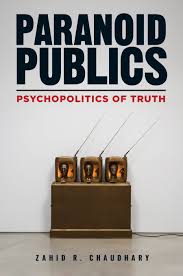
Zahid R. Chaudhary
Paranoid Publics: Psychopolitics of Truth
Fordham University Press, 2025
224 pages
$27.95
Reviewed by Alejandro Madrigal III
Over the past decade, publics across the United States and Europe have borne witness to the steady mainstreaming of far-right politics, fascist authoritarianism, and state support for (or indifference toward) the erosion of democratic practices and institutions. This mainstreaming has coincided with what some pundits and commentators have called a “post-truth” era. In such an era, conspiracy theorizing and the flouting of scientific consensus are the norm, giving way to opinions, feelings, and at times outright falsehoods. Indeed, what began as fringe QAnon logic in the uptick to the 2016 US presidential election is now readily at work in public news media, state and federal legislative bodies, and in the comment sections of New Media spheres like Instagram, Facebook, TikTok, and X (Twitter). What is more, proselytizers of this logic are no longer cordoned within the American Right but run the political gamut.
In Paranoid Publics: Psychopolitics of Truth, Zahid R. Chaudhary asks a different question than post-truth analyses: what if current dilemmas about truth are not just a matter of disagreement between what is/is not true, but an indication that the mechanisms by which we ascertain and are beholden to act in accordance with the truth have weakened? Threading psychoanalysis and Foucauldian genealogy, Chaudhary assesses the untethered state of truth vis analyses of paranoia and fantasy within groups as seemingly disparate as whistleblowers, Moms for Liberty, QAnon, government spies, and asylees in Sweden. For Chaudhary, this analysis involves recognizing the shifting terms of contemporary games and regimes of truth. In the Foucauldian sense, games of truth refer to context-specific ways of arriving at and apprehending truth, while regimes of truth “bind” individuals to the truth (once apprehended), requiring them to submit to and act in accordance with it. Regimes enforce submission through subtle or systemic exercises of power, making submission and feel self-evident or “obvious.” Yet, Chaudhary argues, the collective forces binding individuals to the truth have weakened. Rather than attempt to re-tether truth through explanations of resentment toward class disparities or political-material differences, Chaudhary presents these disparities and differences as intimately enmeshed with psychosocial processes and psychic realit(ies) that link bodies and minds to new games and regimes of truth that cut across sociocultural, political, and economic difference. In this way, Chaudhary offers that psychosocial states like paranoia are not so much an aberration from historical conditions but emerge out of these conditions—which in present times include, for example, strategic data capture, animated and exclusionary border politics, and varied degrees of neoliberal governance and reform.
In Chapter One, Chaudhary uses the example of whistleblowing to demonstrate how contemporary games of truth are underwritten by a logic of exposure. Rather than accord truth with outcomes of justice, for example, a logic of exposure prioritizes those moments where truth is ‘exposed’ to the public. These moments can carry cultural currency, whether through satisfaction that one ‘knew it all along,’ or through the pleasure experienced when one flouts an accepted truth and acts in spite of it. Further, in a time of ubiquitous online media participation and surveillance capitalism, exposure operates as a modus operandi—we are exposed to and by social media companies, the State, and ourselves—and by which we attempt to mitigate the intermixing of “threats to life” and “the threat of being found out.” While these threats have always existed for marginalized populations, current political-economic processes and their associated social conditions increasingly render exposure a collective mood. Heightened anxiety, affectual attenuation, and paranoia “suture” such strange bedfellows as then-Sandy Hook denialist Alex Jones and jade egg-purveyor Gwyneth Paltrow.
Chapter Two focuses on the “transit from paranoid ideation to political action.” Drawing on Sigmund Freud, Chaudhary writes that paranoia represents “an effort to hold together a world that seems to be disintegrating.” The paranoiac’s delusions constitute an attempt at recovery in a disintegrating world; paranoia offers a chance at respite and reconstruction that promises to hold the world, and thus oneself, together. Paranoid politics, such as those held by QAnon believers, thus act as a counter-knowledge amassed to relieve “psychical tension” within the social realities of given historical conditions (i.e., late-stage capitalism and subjectivation within neoliberal political economy). That is, by purporting to expose some secret truth, conspiratorial explanations and their associated fantasy realms offer a “healing attempt.” A gamified digital social sphere, in combination with group psychodynamics, contributes to what Chaudhary calls “LARPolitics,” or a Live-Action Role Play (LARP) of gamified paranoia that is as politically activating as it is epistemically flexible.
Chapter Three analyzes what ‘freedom’ entails for right-leaning paranoid publics. Chaudhary argues that the rhetoric of parental rights and medical freedom groups is in part rooted in the believed exemption and sacrosanctity of the nuclear family. The paranoia these groups experience—of families and bodies under attack by diversity, equity, and inclusion (DEI) initiatives, drag queen story hour, and ‘bad’ vaccines—paradoxically yields to a type of authoritarian freedom. This authoritarian freedom is meant to both exempt these groups from contemporary juridical management while foretelling a new world order that harshly polices the boundaries of exemption. Within contemporary right-wing politics, desires to yield to authority are expressed in discourses about national purity, white supremacy, and border security. Importantly, paranoid fantasy as political practice carries self-fulfilling implications. In Chaudhary’s words, “Because one has disrupted drag queen story hour, for example, and faced some resistance in doing so, this event must be part of a concerted effort to turn kids queer.” Resistance to political action based on paranoid delusions reinforces beliefs about untold powers ‘out to get you/me.’ The heightened sense of vulnerability to powers-that-be that follows such reproach may accelerate yearnings for cataclysmic change that, it is assumed, the sacrosanct nuclear family will endure.
In Chapter Four, Chaudhary presents an analysis of border politics using the phenomena of Havana Syndrome among American diplomats and spies alongside Resignation Syndrome among asylees in Sweden. To parse these cases, Chaudhary turns to the concept of hysteria. Rather than offer solutions or diagnoses, Chaudhary approaches hysteria as an analytic to forward psychoanalytic hermeneutics. This approach considers not only the psychical realities of persons affected, but the interplay among the unconscious fantasies of individuals, the collective imaginaries of the societies of which individuals are a part, and the ways in which unconscious demands manifest through hysterical symptoms in response to both real and perceived hostilities of the social environment. Chaudhary offers that tracing the “psychopolitical outlines” of these hysterical mysteries can better bound remaining and deeper unknowns “about the body and its receptivity to the social.” As emphasized in the closing Coda, such a practice of engaging with the psychopolitical unconscious has the benefit of revealing a far larger, stranger, and psychically layered domain of contemporary politics, as well as the contestations over truth that sustain it.
Paranoid Publics is a thorough, timely, and theoretically sophisticated assessment of the politics of ‘truth’ in our contemporary political landscape. Moreover, the work is far from close-ended. Chaudhary presents a potentially fruitful jumping-off point for deeper investigation into psychopolitical dynamics within specific fields, such as healthcare and education. This said, Paranoid Publics is less friendly to the uninitiated, and at least a cursory knowledge of psychoanalytic concepts or literature would benefit readers. This threshold for entry can feel disappointing when, arguably, folks inside and outside academia could benefit from a deeper, layered understanding of the current political moment and the slippages of truth within it.