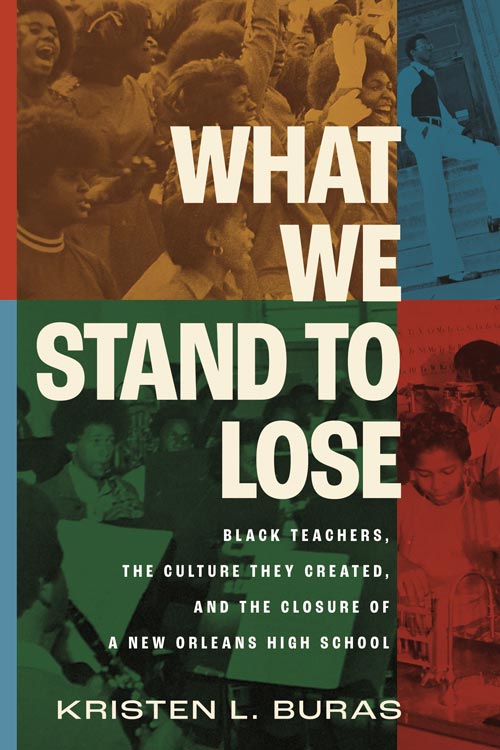
Kristen L. Buras
What We Stand to Lose: Black Teachers, the Culture They Created, and the Closure of a New Orleans High School
Beacon Press, 2025
275 pages
$20.95
Reviewed by Daniel Dawer
On August 29, 2005, Hurricane Katrina made landfall on the Louisiana coast. Within hours, fifty-three levees across New Orleans failed, flooding entire neighborhoods and displacing hundreds of thousands of residents. Nearly 1,400 people lost their lives, and the storm caused an estimated $125 billion in damage. Yet in Katrina’s immediate aftermath, a second storm was brewing—one that would effect a sweeping transformation of the city, and in particular, its public schools.
In the months that followed, state officials and business leaders advanced a coordinated effort to rapidly restructure New Orleans’s education system. Under the authority of the state-run Recovery School District, virtually all of the city’s public schools were converted overnight into charter schools operated by private managers. Crucially, these schools would not be staffed by the educators who had served New Orleans’s children for generations. Instead, in November 2005, the district’s majority-Black veteran teaching force was terminated en masse and supplanted by younger, whiter, and less-experienced replacements.
This rapid succession of events was justified by an ascendant narrative that painted the New Orleans Public Schools as a “failing” district, where chronic underperformance lay at the feet of ineffective black teachers and the bureaucratic structures that protected their intransigence. Aligned with this narrative, Katrina was framed as an unfortunate but ultimately-welcome opportunity to wipe the slate clean and reimagine a new and improved school system from the ground up. Unlike the traditional school system that preceded it, this new, all-charter system would be organized as an educational marketplace guided by neoliberal principles of choice, competition, and privatization.
Yet the narrative undergirding this project of disaster capitalism was not only inaccurate—it reflected an intentional erasure of history. In What We Stand to Lose: Black Teachers, the Culture They Created, and the Closure of a New Orleans High School, Kristen L. Buras—an anti-racist scholar-activist who has led community-centered education research and advocacy in New Orleans for over thirty years—shows that the city’s historically-black schools before Katrina were not sites of abject failure or systemic dysfunction. Rather, they were spaces where black teachers instilled a sense of community and purpose and black students developed an ethic of self-determination and achievement amid a broader political context of systemic racism. Through an in-depth historical exploration of George Washington Carver Senior High School from 1958 to 2005, Buras reveals that the decline of schools like Carver occurred due to decades of policy decisions that deliberately marginalized, underfunded, and destabilized them. By excavating this suppressed history, Buras reveals exactly who and what post-Katrina education reforms displaced, and at what cost to their learning, well-being, and political power.
Employing an anti-oppressive historical research approach drawn from the black intellectual tradition, Buras frames the book as a project to ‘re-member’Carver, or as an attempt to recover and stitch back together the heritage knowledge of marginalized communities subjected to centuries of cultural fragmentation. Drawing on archival materials and oral history interviews with nineteen former students and twelve teachers, Buras centers the perspectives of Carver RAMs—the letters standing for the school’s motto of “Righteousness, Achievement, and Mastery”—across multiple generations. In doing so, she demonstrates that the deficit-laden perspectives outsiders held about Carver did not reflect the reality of community ownership, academic excellence, and sense of collective identity experienced by its insiders.
In the book’s second and third chapters, Buras contextualizes Carver’s origins in Jim Crow-era New Orleans. Constructed in the immediate wake of the Supreme Court’s 1954 Brown v. Board of Education decision, Carver was sited next to the federal Desire Housing Project in the underdeveloped Ninth Ward as part of an effort to maintain racial segregation under the guise of “separate but equal.” Yet, from Carver’s founding, its teachers and students refused to be marginalized. Instead, they worked to transform the school through a project of radical placemaking, repurposing it as a site for prefiguring a world that did not yet exist. Drawing an analogy to the Maroon colonies of formerly enslaved Africans that had once occupied the very same swampy margins where the school was built, Buras shows how teachers and students extended historic freedom struggles by establishing a network of intergenerational ties, developing a dual commitment to academic excellence and civic consciousness, and challenging white supremacy through visible and infrapolitical forms of resistance.
Illustrated by yearbook photographs and the firsthand testimony of teachers and students, Chapters Four through Eight examine these dimensions of the unique school culture that emerged at Carver. Buras traces how sustained relationships between generations of educators and students fostered a close-knit community where, in the words of one Carver graduate, teachers “could tell you who you were.” Teachers and coaches leveraged the school’s material constraints as assets for imparting an ethic of self-determination and resilience, while simultaneously equipping students with the navigational capital necessary to confront a racially-hostile world. Tapping into the rich cultural traditions of black New Orleans, Carver’s educators and students forged a collective identity grounded in principles of mutual association, belonging, and community pride.
In the book’s final two chapters and epilogue, Buras chronicles the chain of structural violence that led to Carver’s unravelling, conversion to a charter school, and eventual closure. For decades, black schools in New Orleans experienced systematic underfunding as their facilities were left to crumble. As a result, when Carver reopened as a charter school in the wake of Katrina, its new operators invoked a narrative of historic dysfunction to justify adopting a “no excuses” model of instruction and discipline. When the school closed in 2015, the culture of self-determination, academic excellence, and radical black consciousness that had sustained it for generations had been hollowed out, replaced by a punitive educational philosophy detached from the lived realities of black New Orleanians. Situating Carver’s shuttering amid a wave of school closures targeting predominantly-black schools in urban districts across the country, Buras concludes by calling on communities to tell the unofficial histories of their schools, documenting how they served as sources of community cultural wealth and how they endured sustained neglect at the hands of state and district officials.
Buras stops short of providing specific policy recommendations or courses of action that people can take to reverse the course of disruptive reforms like state takeovers, charter expansion, or school closures. While Buras’s decades of service as a community-embedded scholar and activist certainly attest to her commitment to advancing change, readers looking for concrete plans for resisting the advance of neoliberal education reforms in their own communities might be left with more questions than answers. It would have been especially compelling to see how the inheritors of Carver’s legacy are continuing their resistance efforts today, or how they are advancing new counter-narratives to contest the market logics that continue to guide New Orleans’s virtually all-charter district.
Regardless of this omission, What We Stand to Lose serves as an exemplar for researchers, community advocates, and educators who seek to uncover suppressed histories of resistance to systemic racism. Buras reminds us that schools like Carver, and the teachers and students who passed through their hallways, did not fail; they were failed by policymakers who ignored the value they generated for communities beyond the test scores they produced. In recovering Carver’s history, Buras compels us to account for the real costs of converting schools from collective assets into disposable commodities and encourages us to build the collective power required to defend public schools as essential community institutions.