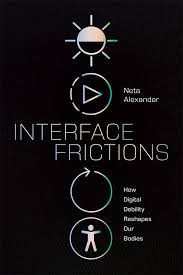
Neta Alexander
Interface Frictions: Digital Debility and the Politics of Design
Duke University Press, 2025
232 pages
$28.95
Reviewed by Giulia Oprea
In Interface Frictions, Neta Alexander asks if the fatigue, headaches, and anxiety typically associated with constant digital tech use are random side effects or built-in consequences of how their interfaces are designed. Instead of treating fatigue as a personal failure or a byproduct of constant connection, Alexander argues that contemporary platforms and interfaces normalize exhaustion by quietly training users to endure more, scroll longer, and click faster. In these ways, people are encouraged to override their bodily limits in the name of efficiency, personalization, convenience, and a supposedly “seamless” digital experience.
The book’s critical contribution is a concept Alexander calls digital debility. Drawing on Jasbir Puar’s concept of ‘debility’ in The Right to Maim: Debility, Capacity, Disability (2017), Alexander adapts the term to describe a related-but-distinct condition shaped by digital media. In Puar’s work, debility is discussed as the ongoing, structural wearing-down of populations through political and economic systems, particularly in relation to state violence and global inequality. Alexander, on the other hand, applies this framework to the domain of everyday digital life. For her, ‘digital debility’ includes things like the headache after a day of videoconferencing, the cognitive fog from multitasking, the insomnia triggered by autoplay, and the emotional exhaustion that can follow unexpected exposure to traumatic content. These experiences are widespread and increasingly normalized, but they are rarely framed as structural harm. Instead, they are usually minimized as some inevitable cost of connectivity and on-demand entertainment.
By introducing digital debility into media studies, Alexander wants to reframe how we think about the significance of interface design. Interfaces do not just respond to a user’s needs; they also actively shape the kinds of bodies, attention spans, and daily rhythms that are idealized or standardized. Features such as infinite scroll, autoplay, playback speed, refresh buttons, and night mode are typically marketed as conveniences and tools of personalization. However, Alexander argues that these features can train users to override their physical and emotional warning signals—such as fatigue, discomfort, and overstimulation—in order to continue engaging. What might look like empowerment or choice can also function as a subtle form of discipline or conditioning. The “ideal” user for these interfaces, it would seem, is the one who adapts, endures, and keeps going, even when their body signals that it needs to rest.
At the same time, Alexander does not fall into the trap of declaring technology inherently harmful. One of the book’s more nuanced moves is an insistence on technology’s ambivalence; Alexander understands that an interface feature that is enabling for some users can also be debilitating for others. Playback speed, for example, has been essential for blind and deaf viewers who rely on audio description or captions, and for neurodivergent users who might process speech more effectively at different speeds. People with chronic pain or limited energy may need to adjust pacing in order to conserve time and stamina. Alexander does not question these needs; instead, she questions how and when platforms frame and mobilize them.
Her analysis of Netflix’s playback-speed controversy is an especially engaging example of this mobilization. When Netflix first tried out speed controls, filmmakers protested, saying it violated artistic intent, causing the company to initially shelve the feature. When it reintroduced playback speed in 2020, Netflix framed it as an accessibility tool for blind and deaf users. Alexander argues that this shift was strategic: accessibility was invoked not to transfer platform power to users, but to deflect previous criticism and protect engagement metrics. She calls this “cripwashing,” or the practice of using disability rhetorically and strategically to legitimize design decisions that are still driven by profit and data extraction. In these cases, disabled users are cited only when it’s convenient and are rarely taken seriously as design authorities.
Throughout the book, Alexander effectively moves from small interface actions to broader political questions. In the opening chapter, she examines the seemingly simple act of refreshing a page, reading each pull-to-refresh gesture as a form of bodily training that conditions users to anticipate updates, remain alert, and wait. What seems like choice becomes habit, and what feels like agency becomes an act of repetition. This analysis sets the tone for the rest of the book: interfaces are not just technical systems, they are also affective environments that shape how we relate to time and to our own bodily limits.
Chapter Two deepens this focus by examining speed-watching. Alexander complicates the popular “productivity hack” narrative by arguing that control over playback speed can function as a technology of calibration rather than just acceleration—for many disabled users, adjusting speed is about managing energy and comprehension, not consuming more content in less time. Yet platforms still benefit when users speed up, watch more, and generate more data. Speed is a survival strategy for some and an extraction mechanism for others.
Chapter Three demonstrates that emotional harm can be built into a platform’s default settings. Drawing on the concept of ‘platform violence,’ Alexander discusses how automated previews and autoplay features can expose users to graphic violence or traumatic imagery without their consent, tracing autoplay’s origins to Netflix’s focus on subscriber retention and hours-watched metrics. For users with PTSD or histories of trauma, unexpected exposure to violent content can be destabilizing. The chapter ends with a compelling counterexample in Michaela Coel’s I May Destroy You, whose weekly release format Alexander frames as a “crip intervention”—a refusal of the demand to accelerate and consume, preserving space for rest, reflection, and nonlinear healing.
Chapter Four turns to so-called soporific media, revealing that even rest has become a site of extraction and profit. Night modes, wearable technology, and apps like Calm promise to solve fatigue but individualize and monetize exhaustion rather than addressing its structural causes. Sleep stories in the Calm app are designed to be forgotten, functioning as soothing background noise, while the labor behind these platforms remains largely invisible.
The book’s coda situates digital debility within the pandemic-era shift to videoconferencing. ‘Zoom fatigue’ quickly entered public discourse, but proposed solutions focused on productivity hacks rather than structural critique. Remote work promised flexibility while reinforcing expectations of constant availability; self-view windows intensified self-surveillance; homes became offices and backdrops. Alexander calls this “consensual impairment:” users accepting cognitive and physical strain as unavoidable.
Rather than offering a checklist of design fixes, Interface Frictions ends by urging us to rethink what we should expect from digital life. Friction—pauses, limits, refusals—is offered here as a political tool. Alexander suggests that seamlessness is not inherently humane, because when interfaces disappear into the background, moments of decision and recalibration can disappear with them. The more invisible the interface, the more difficult it becomes to identify harm or demand change.
This book will be especially valuable for scholars in disability studies, media studies, science and technology studies, and political economy. Its distinctive contribution lies in foregrounding exhaustion and trauma as infrastructural effects rather than individual shortcomings. At times, the book can be more diagnostic than prescriptive, and readers looking for straightforward design alternatives might find its refusal of solutionism frustrating. However, this restraint is a strength. Alexander refuses the comforting fantasy that ‘better’ interfaces alone can fix larger structural problems rooted in platform capitalism and instead offers a language for recognizing harm where it has long been minimized and overlooked.