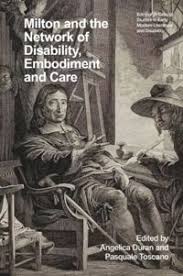
Duran, Angelica, and Pasquale Toscano, editors
Milton and the Network of Disability, Embodiment, and Care
Edinburgh, Edinburgh University Press, 2026
298 pages
$125.00
Reviewed by Jared Nabhan
The relationship between John Milton’s blindness and his poetic works has been of continual interest to scholars. Angelica Duran and Pasquale Toscano’s Milton and the Network of Disability, Embodiment, and Care (heretofore referred to as “DEC”) expands the now-orthodox mode of scholarship examining Milton’s personal life, political prose, poetry, with the “advantageous heuristic lens” of disability, embodiment, and care. Through meticulous readings of Paradise Lost, Paradise Regain’d, and Samson Agonistes—among other poems—and his polemical works, this edited volume explores how Milton negotiates the tension between societal stigma and moral authority, offering a nuanced account of how vulnerability, physical difference, and social responsibility intersect in his composition. This results in a well-rounded study of Milton’s engagement with—and resistance to—early modern understandings of disability.
The volume is divided into four sections. The first provides vital context and terminology and explains how this text joins contemporary DEC scholarship. The second focuses primarily on representations of DEC within Milton’s oeuvre. Section three compares Miltonic texts to those of other seventeenth-century authors. The final section utilizes this context to highlight how nineteenth- to twenty-first-century authors have creatively engaged DEC through Milton’s texts. The organization of this book proves beneficial to readers, each chapter adding necessary scaffolding for later ones. Joe Moshenska’s chapter, for example, uses the myth of Milton’s stammer as a springboard to discuss early modern ideas about the speech impediment. This research contextualizes early modern ableism, which Milton himself resisted. Susannah Minty continues this discussion in her chapter, wherein she records Milton’s subversion of contemporary critiques of his blindness—attacks that alleged God inflicted blindness upon him as retribution for his support of regicide. Later in the book, Teri Fickling returns to Milton’s detractors and cites Sonnet 22 as an explicit defense against their accusations. The organizational format thus maintains a clear line of continuity, bolstering readability.
The highlight of the book is Elizabeth Sauer’s and Timothy Harrison’s study of human incapability; the former investigates the postlapsarian condition whereas the latter looks at man’s prelapsarian state. Sauer, like Minty, observes that Milton embodies his blindness in a redirected manner. After analyzing Sonnet 19, 22, and Defensio Secunda, she argues that Milton views his disability not as a debilitating restriction, but as an “incitement to action.” Milton, Sauer suggests, redirects his impairment into a disciplined exertion of poetic and political agency “for the sake of liberty.” Sauer identifies this theme in Books 11 and 12 of Paradise Lost where Adam learns how to live with his fallenness. While Adam laments that time is a “slow-paced evil” (10.963), bringing people closer to death with every second, Sauer insists that Milton “reimagines the human condition in its worldly, lapsed state” by situating ageing not only as a disability, but as an opportunity.
Harrison masterfully connects Milton’s logical definition of privation found in his Ars Logicae to his theological definition of a human in De Doctrina Christiana. He relates his research to the epic by examining every instance in which the word “incapable” occurs, identifying a consistent usage and meaning of the term: the complete denial or negation of a capacity in a subject whose essence includes that capacity. Then, invoking Milton’s claim that humans are marked—among other criteria—by rational distinctiveness, Harrison invokes Aristotle’s assertion that to choose—and what is reason but choosing—one must negate, or deny, another option. Therefore, he deduces that “[f]or Milton, negation is integral to anthropology.” In a powerful turn, Harrison concludes his chapter by scrutinizing Eve’s mistaken belief that she is “incapable” of pain or death. Eve’s deduction rests upon the false premise of a “negation of a negation.” Her failure to apprehend human nature through right reason allows Harrison to identify a philosophical anthropology of the poem. As Harrison argues, “Milton suggests that all our human abilities, inabilities, and disabilities are conditioned by a deeper, more primordial capacity for negation that is constitutive of human being as such.”
Milton and the Network of Disability, Embodiment, and Care certainly succeeds in its goal to expand DEC scholarship within Milton studies. Each chapter provides novel insight into Milton’s sustained engagement with bodily limitation, dependency, and care, revealing these conditions not as afflictions, but as empowering forces that shape his poetic, personal, and theological ingenuity. A limitation of this lies with chapters such as “Milton’s Stammer,” which heavily rely on a personal reading of Milton’s work. While we cannot know for certain that the syntax of the opening lines of Paradise Lost intends to reflect the verbal obstacles with which those who stammer struggle, to imagine such an effect remains a useful critical exercise, one that elicits sympathy for the embodied experience of stammering. Nevertheless, this work provides needed context to any Miltonist engaging with the poet’s career post-blindness. It proves valuable not only to Milton scholars, but also to those seeking a fuller comprehension of early modern ableism and the entrenched prejudices that individuals were compelled to confront and surmount.