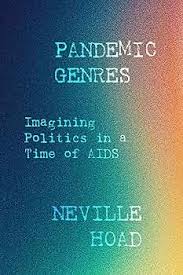
Neville Hoad
Pandemic Genres: Imagining Politics in a Time of AIDS
University of California Press, 2025
264 pages
$34.95
Reviewed by Courtney Welu
Neville Hoad’s Pandemic Genres: Imagining Politics in a Time of AIDS is the first book of its kind; it is the only single-author monograph to substantively examine the literature and culture produced about the ‘African’ HIV/AIDS pandemic, with the understanding that Africa is not monolithic and time and location matters significantly when discussing cultural and policy shifts. Through the lens of genre—including but not limited to novel, memoir, poetry, and film—Hoad posits that imaginative works can offer the possibility of new imaginaries of HIV/AIDS. Hoad is particularly concerned not just with the “tropes, figures, and rhetorical strategies” of the genres he analyzes but with how these genres play out “on the terrain of feeling.”
Chapter One, “Beauty Pageants. Figuring Out Miss HIV” is the most distinctive chapter, as the beauty pageant is a cultural genre that we do not often associate with our imaginative faculties. Hoad breaks down the idea of a ‘Miss HIV,’ a beauty or drag queen who represents the disease itself. She exists in John Greyson’s 1993 musical Zero Patience, in the real-life 2003 Botswana pageant ‘Miss HIV Stigma Free,’ and in the documentary film Miss HIV that criticized Botswana’s pageant for normalizing HIV-positive status. The chapter relates the North American concept of the primarily gay male HIV/AIDS pandemic to the substantively different African HIV/AIDS crisis and the politics of Botswana’s AIDS prevention response.
Chapter Two analyzes Adam Levin’s memoir, Aidsafari, which provides a South African example of the well-worn international genre of the “gay AIDS memoir” anchored in Johannesburg in the early 2000s. Hoad is particularly attuned to the gay culture, the music, and the nightclub scene that Levin describes because he was one of Levin’s contemporaries, although they did not know each other well. This chapter is Hoad’s most personal: he shares his recollections of Levin, their larger social circle, and amusingly, their “fake woke” politics. Hoad deems these descriptions a “prehistory of the memoir,” but they comprise one of the most compelling sections of the book. If Hoad is attempting to build an “archive of the imagination of AIDS,” it’s through his own recollections that he succeeds most in illustrating a “terrain of feeling” for readers.
Chapters Three and Four focus on more traditional close readings of film and poetry. Chapter Three examines the isiZulu-language film Yesterday (2004), which centers a young mother in rural KwaZulu whose husband infects her with HIV. Hoad critiques the film’s “family values” and its emphasis on monogamous, heterosexual marriage— which helped the film gain sympathy from a Western audience—even though such a marriage is “out of time and place” in its setting and a “material impossibility” for its protagonists.
Chapter Four, meanwhile, is preoccupied with “the role of affect in public life” and how poetry about the pandemic “work[s] out the relation between illness as a profoundly subjective, embodied experience and a public one.” By looking at poems by South African writers Phaswane Mpe and Ingrid de Kok, Hoad shows how poetry can “suggest how other forms of public discourse around the pandemic on issues of prevention campaigns and testing are consumed, misread and contested,” as well as represent despair and shared suffering. Hoad carefully situates Western scholarship on public feeling within a South African context while acknowledging the “salient differences” between North American and African experiences—a motif of many of the book’s chapters that is most potent here.
Chapter Five takes two young adult novels—Carolyne Adalla’s Confessions of an AIDS Victim (1993) and Lutz Van Dijk’s Stronger Than the Storm (2000)—and relates their portrayals of HIV to an NGO’s ‘best practices’ that fail to account for radically different circumstances in time and place, as the ‘African’ HIV/AIDS pandemic is not monolithic, even if neoliberal institutions like the NGO treat it as such. These best practices “become the way for experts who seem unconcerned with the life worlds rather than the practices of those they wish to help to create a simulacra of change,” and therefore the novels, which rely on configuring their protagonists as victims, become complicit in “enabling the material conditions of their publication.”
In Chapter Six, Hoad close-reads Kgebetli Moele’s The Book of the Dead (2009) as a representation of ‘documentary citizenship,’ wherein the titular book of the dead, authored by HIV itself, stands in as “a murderous substitute for the sovereign state in a vicious fantasy about the necessity and dangers of counting and discounting Black life in a long crisis of social reproduction.” The book is divided into two sections (The Book of the Living and the Book of the Dead); the latter is authored by a personification of HIV “somewhere between a diarist, an omniscient narrator, and state information functionary.” The protagonist, Khutso, and HIV collude to record all of the infections for which Khutso is responsible, creating a faux “archive of Black sexuality” that “counts Black life about as carefully as the apartheid state did.” Both of the central concepts introduced in Chapters Five and Six—‘best practices’ and ‘documentary citizenship’—are culturally-specific and rely on understandings of how empire, capital, and race are central to analyzing the ‘African’ HIV/AIDS pandemic as its own historical genre.
Hoad uses his coda to speculate about the relationship between COVID-19 and HIV/AIDS; whether there is anything we can learn from the prior pandemic about our current one. Although the Trump presidency was unable to outright deny the coronavirus the way that Ronald Reagan and later Thao Mbeki, former South African president, denied HIV/AIDS, Hoad does draw parallels between Trump and Mbeki for their “refusal to trust or deploy scientific studies and imagine how science should drive public health policy,” while also comparing their threats to global capitalism and the lack of an HIV vaccine forty years later while a COVID-19 vaccine was produced within a single year.
If I have a criticism of the book, it is that I found myself wanting Hoad to speak more in his coda about how “the experience of both pandemics is neither sequential nor comparative but simultaneous,” as he briefly acknowledges. What does it mean for the HIV/AIDS pandemic to be ongoing, and how does being HIV-positive exacerbate the threat of COVID-19 in the African context? However, the book is quite successful in its justification of the value of academic work in tracing the past and present of HIV/AIDS in Africa and beyond.